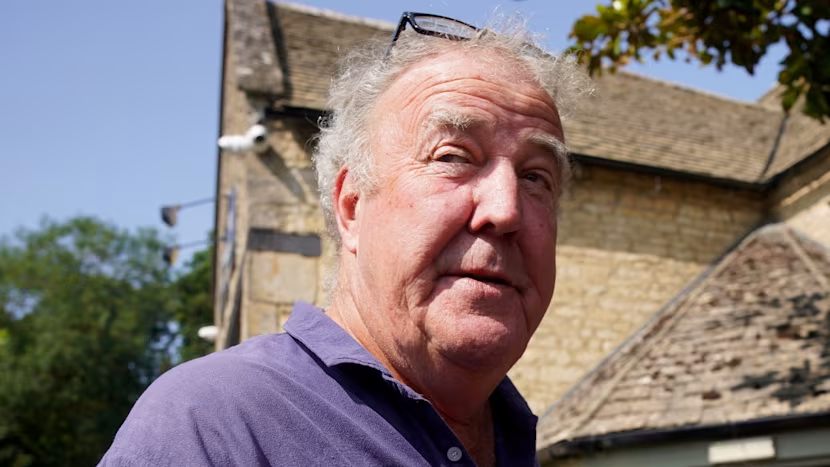
TV presenter and outspoken farmer Jeremy Clarkson has sounded the alarm over what he describes as a “catastrophic” upcoming harvest, warning that the impact could extend far beyond his own fields and affect anyone who relies on the nation’s food supply.
The 65-year-old former Top Gear host, who has spent the last several years documenting the trials of rural life on his Oxfordshire property for the hit Prime Video series Clarkson’s Farm, made the remarks in a series of candid posts on X, formerly known as Twitter. His comments followed the troubling revelation last week that bovine tuberculosis (TB) had been detected on his Diddly Squat Farm.
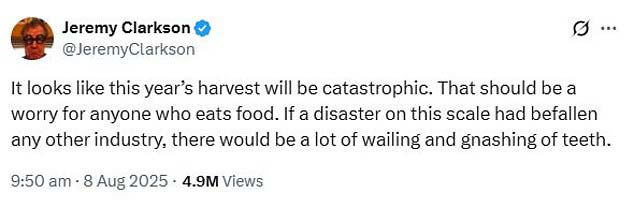
“It looks like this year’s harvest will be catastrophic,” Clarkson wrote on Friday. “That should be a worry for anyone who eats food. If a disaster on this scale had befallen any other industry, there would be a lot of wailing and gnashing of teeth.”
The veteran broadcaster, who swapped the fast-paced world of motoring journalism for the unpredictable reality of agriculture in 2019, made it clear that farming is not a business many can sustain without supplementary income streams. When one user on X suggested that such adversity makes for compelling television, Clarkson agreed—but stressed that the majority of farmers are not buoyed by a global streaming platform.
“Yes,” he replied. “But most farms don’t have TV shows to keep them going.” Asked whether his own operation could survive without the additional revenue from the Diddly Squat Farm Shop and his nearby pub, Clarkson was blunt: “Not a cat in hell’s chance.”
The presenter also pointed to extreme weather as a major factor behind the poor outlook for this year’s crops. “Normal weather would help,” he wrote. “It never stopped raining in 2024 and never started in 2025.” The erratic climate patterns have left fields waterlogged for months on end, disrupting planting schedules and raising the risk of crop disease.
Adding to the strain, Clarkson disclosed last Thursday that a pregnant cow on his farm near Chipping Norton had tested positive for bovine TB—a highly contagious disease that can devastate cattle herds. Under UK regulations, any animal that fails a TB test, or receives inconclusive results on two consecutive occasions, is classed as a “reactor” and must be isolated before being slaughtered.
When asked about the fate of his recently purchased prize bull, Endgame, for which he paid £5,500, Clarkson admitted the animal’s test results had been “inconclusive.” “I couldn’t bear it if we lost him,” he confessed.
Bovine TB, caused by the Mycobacterium bovis bacterium, spreads primarily through close contact, with infected cattle transmitting the disease via droplets of mucus. Wildlife, particularly badgers, can act as carriers—sparking a long-running and contentious government policy of badger culling in certain regions. While supporters argue it reduces disease transmission, opponents, including wildlife campaigners and Queen guitarist Sir Brian May, condemn it as inhumane and ineffective.
In June, the Government confirmed it would not extend the badger cull, reiterating its pledge to phase out the practice entirely before the next general election. Oxfordshire, where Diddly Squat Farm is located, is classed as an “edge area” for bovine TB—meaning it sits between high-risk and low-risk zones. As such, most herds are subject to compulsory TB testing every six months.
Since Clarkson’s Farm first aired in 2021, Clarkson has used his platform to highlight the financial pressures, bureaucratic hurdles, and unpredictable environmental challenges facing British farmers. Beyond the cameras, he has become an increasingly vocal advocate for rural communities, attending protests such as the November 2024 demonstration in London against proposed inheritance tax changes on farmland.
For now, Clarkson’s warnings serve as both a personal lament and a broader cautionary tale. While the spectacle of misadventure may entertain viewers, the reality for many farmers is that without stable weather, disease control, and fair market conditions, survival is becoming less about profit—and more about endurance.
