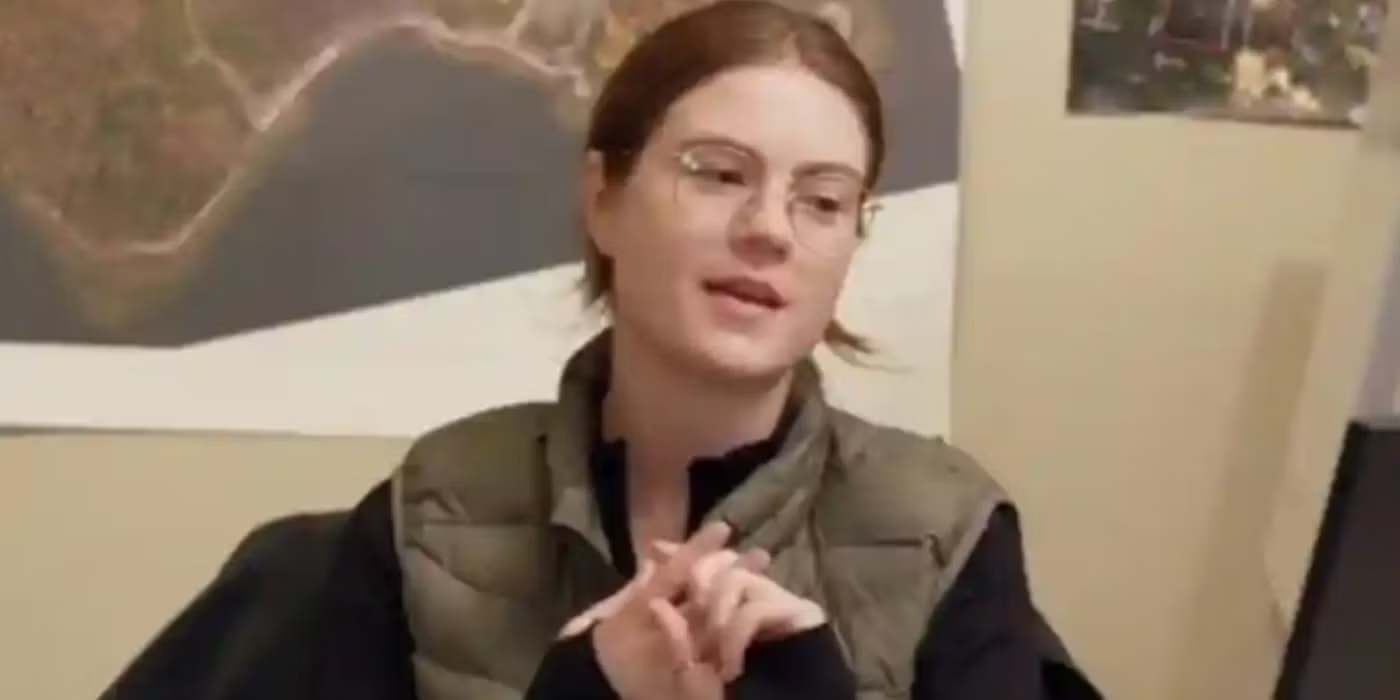
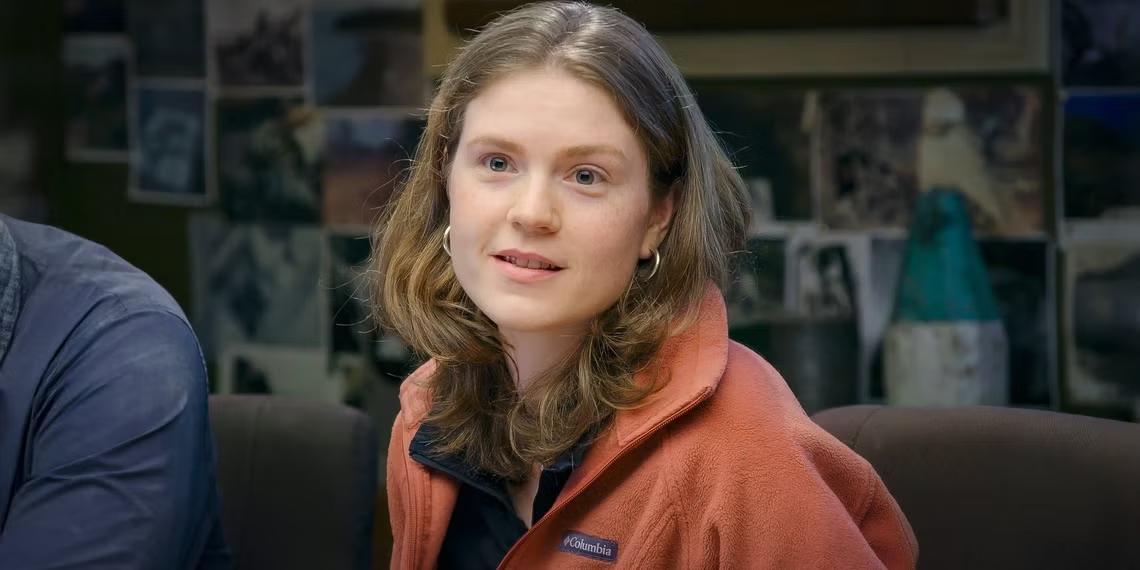
NOVA SCOTIA, CANADA — The mystery of Oak Island has deepened yet again. During the latest season of The Curse of Oak Island, researcher and scientist Emma Culligan made a discovery that could upend centuries of accepted history — a coin that appears to predate the age of European exploration.
Unearthed in a quiet corner of Lot 5, the small, weathered coin was quickly dismissed by some as another colonial artifact. But Culligan, known for her meticulous scientific methods, saw something different. After running a series of X-ray diffraction (XRD) and compositional scans, her data suggested the object could be far older than anyone expected — possibly of Roman origin.
“It’s not what modern coins are made of,” Culligan explained. “This composition screams ancient, not new.”
The Coin That Shouldn’t Exist
According to Culligan’s analysis, the coin’s metallic makeup revealed a core of 70 parts copper, 16 parts lead, and a light surface layer composed of 99.96% pure lead, with trace elements of copper and iron. Those readings, she said, match coins minted during the third century, between A.D. 200 and 300 — the era of the Roman Empire.
If verified, the discovery could point to contact between the Old World and North America more than a thousand years before Columbus — a revelation that would rewrite the history of transatlantic exploration.
“If this really is Roman,” Culligan said, “we have to ask: how did it get here? And who brought it?”
A Scientist Among Treasure Hunters
Unlike many who dig on Oak Island, Culligan doesn’t rely on luck or legend. A graduate of Memorial University, she combines archaeological expertise with advanced technology — portable scanners, spectrometers, and metal analysis tools — to separate myth from measurable fact.
Her quiet precision has made her an unlikely star among the show’s larger-than-life personalities. While others speculate, she measures. When the team hauls an object out of the ground, she’s the one who determines if it’s history or hearsay.
Fans of the series have quickly dubbed her “the island’s brain.” Online discussions praise her for “turning mystery into meaning,” as one viewer put it.
Her lab work, filmed for the episode “Whistle While You Work,” has already sparked debate among historians. If confirmed as Roman, the coin would be one of the oldest European artifacts ever found in North America.
Echoes of Earlier Discoveries
The coin isn’t Oak Island’s only mystery. In previous seasons, the team uncovered the now-famous lead cross near Smith’s Cove — an artifact whose metal was traced to mines in southern France, the same region associated with the Knights Templar. That cross was dated to roughly the 13th or 14th century, hundreds of years before the colonial era.
The connection between the Templar-era lead cross and Culligan’s coin has reignited theories of pre-Columbian exploration — from medieval monks and mariners to ancient Roman traders.
Adding fuel to the debate are other finds: a large iron spike near the island’s swamp, possibly from the early 1700s, and traces of European ship activity logged in French naval records from 1746. Some researchers even claim that constellations mapped over Oak Island align with visible landmarks on the ground — a theory linking the island’s shape to celestial navigation practices used in antiquity.
A Lab of Truth
Back in her lab, Culligan continues to analyze the data. Her process is methodical: each fragment, each trace element, each surface corrosion pattern is recorded and compared to international databases. When the first results came back, her team was stunned.
“The readings don’t match colonial alloys or known 17th-century forgeries,” she said. “They’re closer to Roman compositions catalogued in Mediterranean studies.”
The implications are staggering. If a Roman coin truly lies beneath Nova Scotian soil, it could suggest that ancient explorers — perhaps shipwrecked or on secret missions — reached the Americas far earlier than previously believed.
“It’s a small object,” Culligan added, “but history often starts with something small.”
A New Generation of Explorers
Culligan isn’t the only new face redefining the dig. Alongside veteran detectorist Gary Drayton, his daughter Katya Drayton has joined the team, bringing a second generation of treasure hunters into the search. Her early find — a heavy, rusted piece of iron and shaped wood believed to come from an early shaft — was immediately sent to Culligan for analysis.
That collaboration between field and lab has given The Curse of Oak Island a fresh energy. While previous seasons chased legend, this one chases evidence. Every test, every scan, every element is logged, dated, and scrutinized.
And at the center of it all stands Emma Culligan — calm, analytical, and unflappable. Her work has transformed the show’s approach, shifting it from speculative adventure toward genuine archaeology.
The Past Beneath the Soil
The discovery on Lot 5 may prove to be more than just another chapter in Oak Island’s long saga of mystery and obsession. It could be the opening line in a new history — one that challenges what we thought we knew about who reached North America first.
For now, the team waits for further verification. Additional tests are planned, and new digs are underway in the surrounding area.
But one thing is certain: the quiet scientist who uncovered the coin that “shouldn’t exist” has changed the course of the island’s story — perhaps even the course of history itself.
As Culligan said simply, “We’re not rewriting myths. We’re just following the evidence.”
