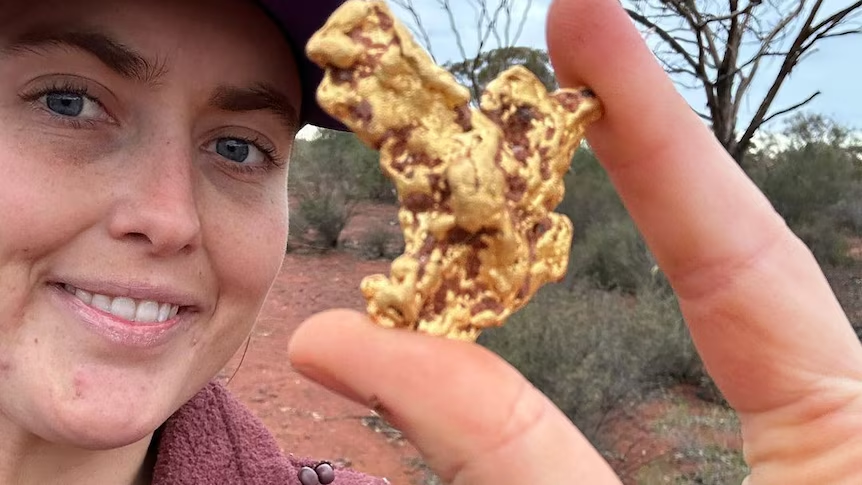
In the vast, sun-baked landscapes of Western Australia, where the red earth hides treasures forged over millennia, gold prospector Tyler Mahoney has built a reputation as one of the most tenacious and knowledgeable figures in the industry. A third-generation gold digger from the historic mining town of Kalgoorlie, Mahoney has spent years honing her skills, navigating rugged terrains, and unearthing valuable finds. As a star of popular reality TV shows like “Aussie Gold Hunters” and Discovery Channel’s “Gold Rush: Parker’s Trail,” she has captivated audiences with her expertise, determination, and passion for the thrill of the hunt. But even for someone as experienced as Mahoney, certain discoveries stand out as truly extraordinary—moments that redefine what it means to strike gold. Recently, she found herself utterly speechless after coming into possession of one of the world’s rarest gold nuggets, a pristine specimen that has sent shockwaves through the global prospecting community.
The story began in the gold-rich fields of Clermont, Queensland, where a local prospector named Alan was out detecting in September 2024. Using a metal detector, he stumbled upon something unusual buried in the soil—a small, 22-gram gold nugget that didn’t look like the typical rounded, water-worn pieces most hunters encounter. Instead, this nugget exhibited an almost flawless geometric structure, with sharp edges and stepped pyramidal faces that resembled an ancient artifact more than a natural formation. Dubbed the “Inca” nugget for its pyramid-like appearance reminiscent of Mesoamerican architecture, it was quickly identified as a hopper crystal, a rare type of gold crystallization that occurs under very specific geological conditions.
Hopper crystals form when the edges of a crystal grow faster than the faces, creating a hollowed-out, stair-stepped shape that looks like a series of stacked rectangles or pyramids. In the case of gold, this is exceptionally uncommon because most nuggets are tumbled and smoothed by rivers and streams over time, eroding away any delicate crystalline features. For a hopper crystal to survive in such pristine condition, it must have formed in a stable environment, perhaps in a quartz vein deep underground, and then been gently exposed without significant disturbance. Experts estimate that only a tiny fraction of gold nuggets—perhaps less than 1%—retain any crystalline structure at all, and perfect hoppers like this one are even rarer, making them highly sought after by collectors and museums alike. The Inca nugget’s sharp, straight lines and near-perfect rectangular facets defy the usual chaos of nature, appearing almost man-made in their precision.
Word of the find spread quickly through prospecting circles, and when Mahoney saw a photo of it shared online, she was immediately hooked. “My jaw dropped to the floor,” she recounted in a social media video that garnered thousands of views. “This is insane—it is one of the rarest types of gold nuggets in the world.” As someone who has dedicated her life to gold prospecting, Mahoney knew this was no ordinary piece. She described it as a “once-in-a-lifetime find” and a “collector’s edition nugget,” emphasizing that even in her line of work, holding something like this was a privilege she might never experience again. Determined not to let it slip away, she entered a heated bidding war with another interested prospector. After tense negotiations, Mahoney emerged victorious, securing ownership of the nugget and bringing it back to Western Australia.

Once in her possession, Mahoney couldn’t help but marvel at its beauty up close. In her posts on Instagram and Facebook, she shared close-up videos and photos, turning the nugget in her fingers to showcase its intricate details. “I’m holding one of the world’s rarest gold nuggets. I will never ever hold anything like this again, and I’m a gold digger; I do this for a living,” she said, her voice filled with awe. She explained the science behind its rarity: “This just does not occur in nature like this. Those perfect straight lines, almost perfect rectangles—shapes like that don’t naturally occur, and that’s what makes it so rare.” If she had found it herself, Mahoney admitted, “I would have never got over it.”
Recognizing its immense collectible value—far beyond its melt-down price of around $2,000 based on gold spot rates—Mahoney decided to put the Inca nugget up for auction. The event drew attention from enthusiasts, jewelers, and collectors worldwide, all eager to own a piece of natural history. Bids climbed rapidly, reflecting the nugget’s uniqueness, and it ultimately sold for an impressive $15,500, shattering expectations and highlighting the premium placed on such geological wonders.
This remarkable episode has not only added to Mahoney’s legacy but has also reignited passion in the prospecting community. In an era where advanced technology and satellite mapping have transformed the industry, stories like the Inca nugget remind hunters that the earth still holds secrets waiting to be discovered. For aspiring prospectors, it serves as inspiration to keep swinging those metal detectors, while for veterans like Mahoney, it’s a testament to the enduring magic of the gold rush. As she continues her adventures on screen and in the field, one thing is clear: treasures like this don’t come along often, but when they do, they leave an indelible mark on those lucky enough to encounter them.
