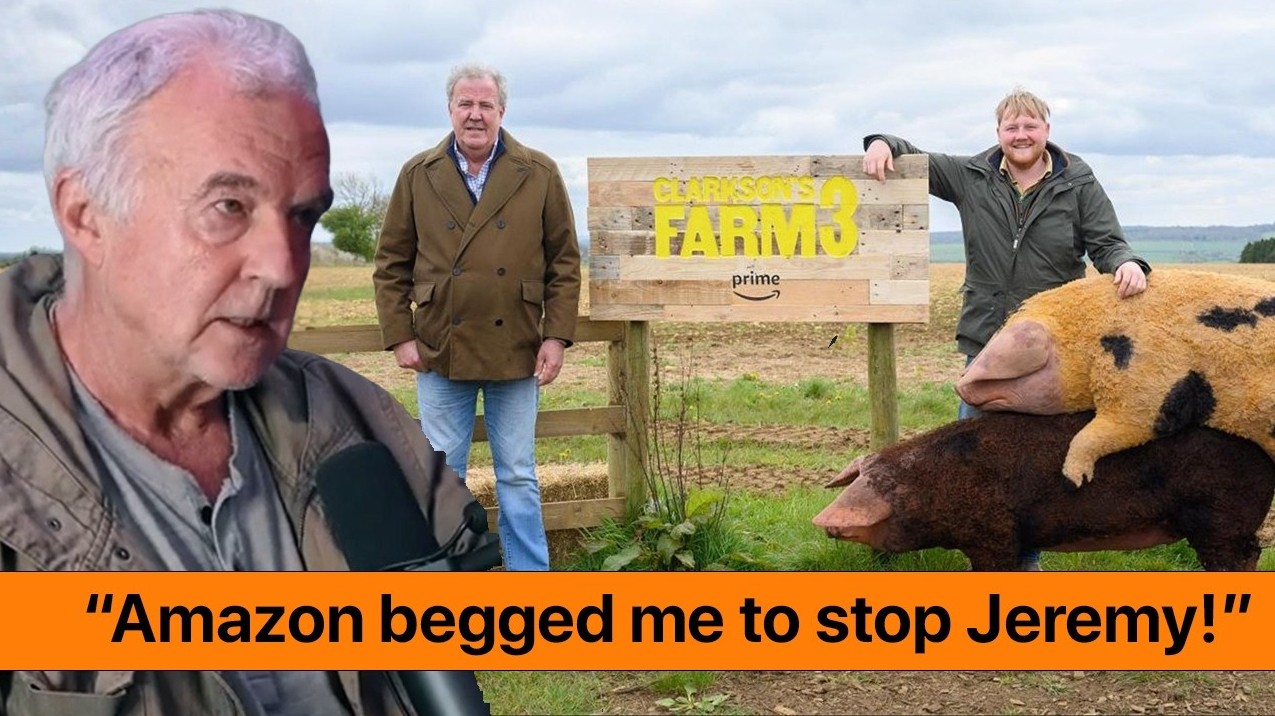
When Jeremy Clarkson first pitched a television series about running his own farm, few expected it to become the defining project of his later career. Least of all Clarkson himself. Yet, several years on, Clarkson’s Farm has quietly overtaken The Grand Tour as the programme most closely associated with his name — not through spectacle, but through something far less manufactured.
Speaking candidly in a recent discussion about the show’s origins, Clarkson acknowledged that the “magic” viewers now associate with the farm series was never planned. “No, we never knew,” he admitted, reflecting on how the project came into being almost by accident. At the time, Clarkson and his former Top Gear colleagues were nearing the end of their initial Amazon deal. The feeling among the presenters was that it might be the right moment to step away, before repetition dulled the appeal.
Amazon, however, had other ideas.
The platform was keen to extend the partnership, offering fresh funding and a novel structure: each presenter would develop an individual solo project alongside continuing commitments. Clarkson’s proposal — a programme documenting life on his Cotswolds farm — was met internally with scepticism. Executives reportedly questioned how such a concept could sustain audience interest, privately urging colleagues to dissuade him.
Clarkson himself shared those doubts. He has since described feeling deeply uncertain about whether the series would work at all, worrying that the day-to-day realities of farming might simply be “boring” television. Unlike The Grand Tour, which arrived burdened with high expectations and a global fanbase, the farm series launched with almost none. That lack of pressure, Clarkson suggested, turned out to be its greatest strength.
What followed were what he describes as “happy accidents” — moments that cannot be scripted or engineered. Central to the show’s appeal has been its cast of ordinary people, many of whom had no interest in television exposure. Farm manager Kaleb Cooper, land agent Charlie Ireland, long-serving farmhand Gerald Cooper, and Clarkson’s partner Lisa Hogan emerged as natural on-screen presences precisely because they were indifferent to the cameras.
Clarkson has often argued that this disinterest is what makes them compelling. None of them watch themselves on screen, and none appear eager to perform. In his view, this authenticity mirrors a broader truth about television: those who do not seek attention are often the most watchable when it arrives.
The programme’s success has also resonated beyond Amazon’s platform. The format has inspired other creators to document local planning battles, rural enterprises, and community life, particularly on YouTube, where similar unscripted series have found large audiences. Clarkson’s reflections suggest that the same principle applies there too — the real stars are often those behind the scenes, unprepared for recognition and largely unmoved by it.
That unpolished realism stands in sharp contrast to Clarkson’s earlier career, built on fast cars, grand locations, and tightly controlled production. Clarkson’s Farm offers none of that. Instead, it centres on weather delays, bureaucratic obstacles, failed crops, and interpersonal friction — all delivered without theatrical framing.
In doing so, the series has reframed Clarkson’s public image. While The Grand Tour remains a high-profile global brand, it is the farm — modest, uncertain, and largely unplanned — that has come to define his recent work. What began as a reluctant experiment has become, by his own admission, the project with the greatest cultural resonance.
Perhaps the lesson is one Clarkson himself seems to accept: television does not always succeed because of ambition or careful design. Sometimes, it works because the people involved never tried to make it work at all.
