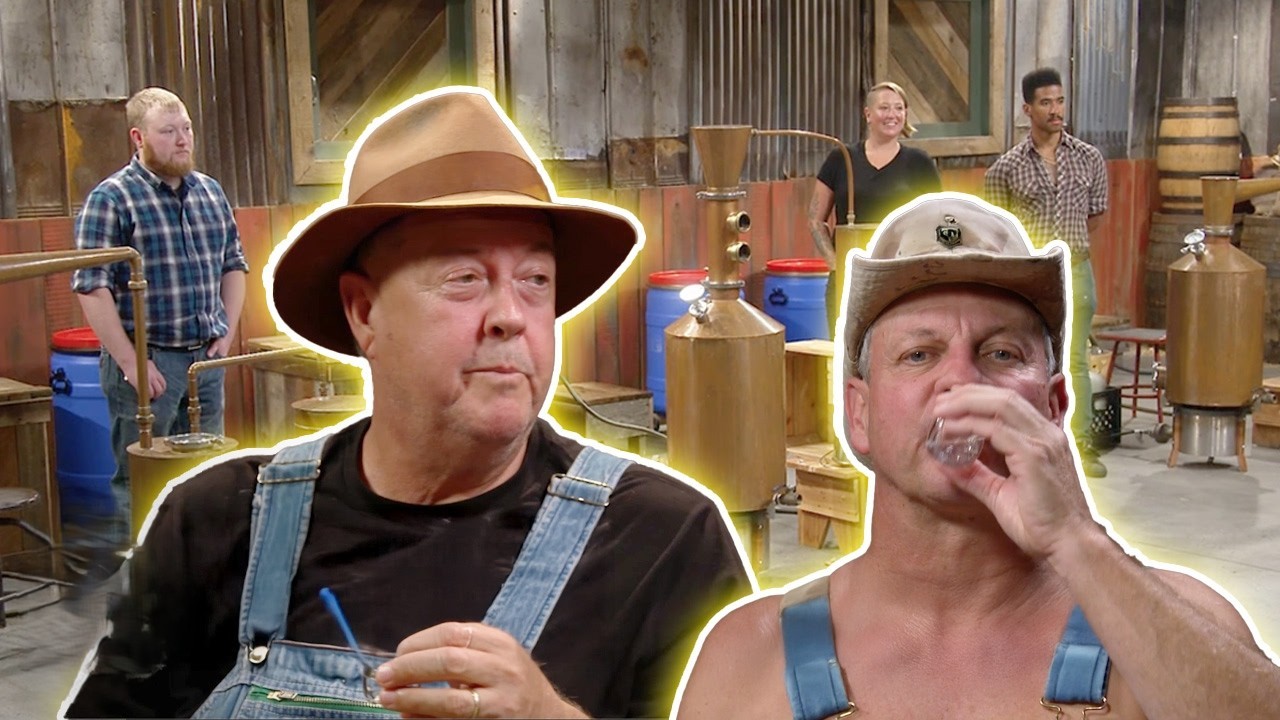
A demanding reverse-engineering task proved decisive this week on Moonshiners, as three competitors were given just four hours to replicate a mystery peach-forward spirit — matching not only flavour and aroma, but also proof.
The brief from the judges was uncompromising: deliver a jar as close as possible to the original 90-proof sample. Any misstep in nose, palate or alcohol strength could mean elimination.
A Technical and Sensory Test
Contestants immediately confronted the complexity of the challenge. Unlike a standard fruit run, reverse engineering required precise layering of mash, fruit and vapor infusion.
Crash opted for subtlety, placing peaches into the column to lightly flavour the vapour. Jalani, working from a larger batch, relied heavily on taste and smell rather than instruments, citing his experience trusting his palate over hydrometers. Dalton, meanwhile, packed significant fruit into his thumper and experimented with orange peel in an attempt to amplify complexity.
Complicating matters further were equipment issues. A cracked solder joint forced one competitor to improvise a temporary seal using oatmeal paste — an inventive but imperfect fix under severe time pressure
Judges circulated midway through the run, pressing each distiller on proof estimation techniques. With no hydrometers permitted, contestants had to rely on traditional “bead reading” — assessing alcohol content by shaking the jar and observing bubble formation.
According to one judge, proof levels across the board were uncertain. “We could get 80 proof or 140 proof,” he warned, underscoring the unpredictability.
The Tasting: Proof Versus Flavour
When time expired, each distiller submitted a single jar for evaluation.
Crash delivered a clean and aromatic spirit, praised for its peach character. However, judges quickly identified a significant weakness: the alcohol strength fell well short of the 90-proof target. “You’re a long way from 90 proof,” one remarked, noting that flavour alone could not compensate for technical accuracy.
Dalton’s entry presented a different issue. While closer on proof, his jar showed visible particulates and slight cloudiness, likely from fruit carryover during blending. The orange peel addition — intended to enhance brightness — was judged to have shifted the profile away from the control sample.
Jalani’s submission, despite aesthetic concerns regarding clarity, impressed on flavour replication. Though marginally low on proof, his spirit most closely captured the nose and palate of the original sample.
The Decision
Judges acknowledged the inherent difficulty of the task, describing it as “damn near impossible” to fully replicate another distiller’s product under such constraints. Ultimately, however, technical balance proved decisive.
Dalton was eliminated.
In his departure remarks, he reflected positively on the experience, describing it as transformative. Accustomed to distilling alone, he said the competition introduced him to a community of like-minded craftspeople with whom he could exchange ideas and refine technique.
Two competitors now advance to the next stage, where they will learn the true composition of the original mystery spirit.
For viewers, the episode served as a reminder that in distilling — as in any craft discipline — precision in proof can matter just as much as flavour artistry.
