Naval Button, 18th-Century Coins and Firearm Fragments Found Near Samuel Ball Property on Oak Island


A series of discoveries on Oak Island has intensified scrutiny of the late 18th- and early 19th-century landowner Samuel Ball, after investigators uncovered artifacts suggesting military links, commercial activity and possible encampment evidence near his former property.
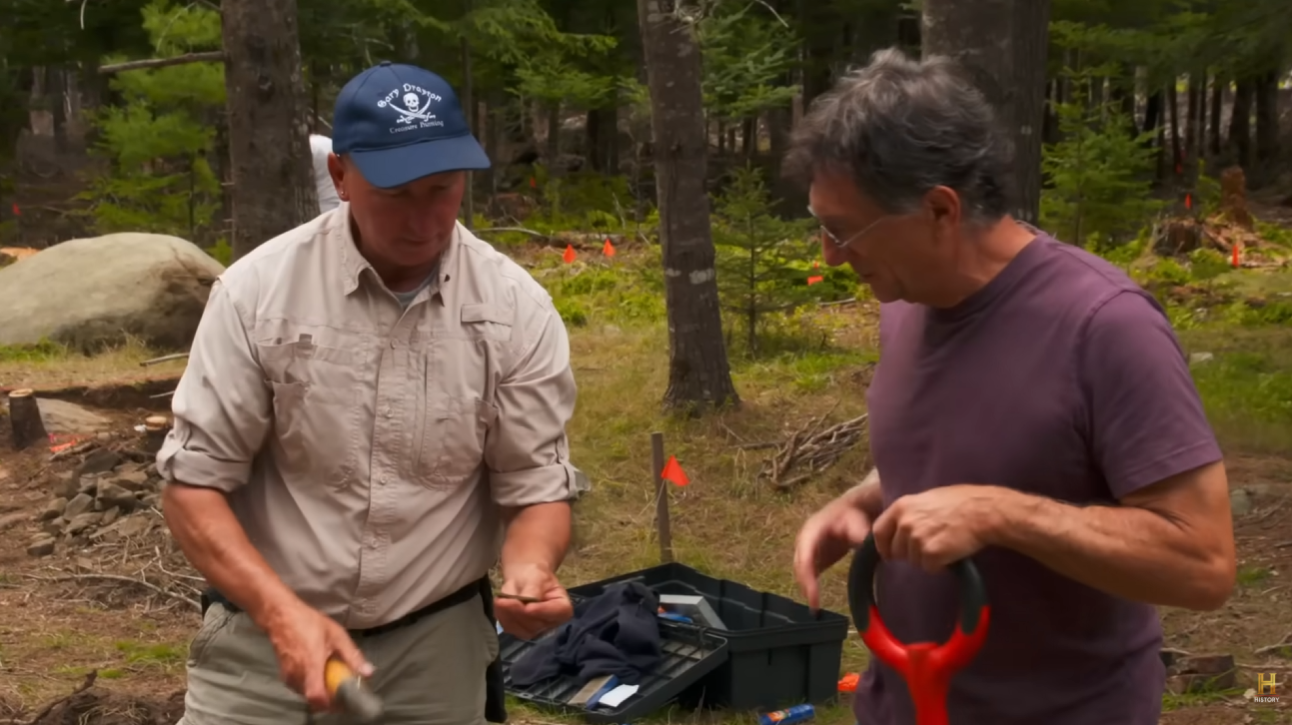
During a metal-detecting sweep on Lot 25, close to the foundation of Ball’s house, Gary Drayton and Marty Lagina unearthed what appears to be part of a gentleman’s pocket knife, followed by a small copper patent plate believed to have been mounted on a musket or rifle.
The plate, bearing the word “patent” in period-style lettering, is tentatively dated between 1790 and 1830 — squarely within the era when Ball resided on the island. Such plates were commonly affixed to firearms to identify proprietary mechanisms or makers’ marks, potentially offering insight into the origin of the weapon.
The find prompted discussion about Ball’s financial standing. Once described historically as a cabbage farmer and former enslaved man who secured his freedom after serving the British during the American Revolutionary War, Ball later became one of Nova Scotia’s wealthiest landowners. The presence of refined personal items and firearm components has renewed speculation that his prosperity may have stemmed from more than agriculture alone.

Further investigation on Lot 26 expanded the narrative. Using a high-powered GPX 5000 metal detector equipped with a large coil capable of detecting objects several feet underground, Drayton and treasure hunter Michael John recovered a small ox shoe. While modest in appearance, the artifact suggests the presence of draft animals, possibly indicating transport or industrial-scale activity in the area.
Archaeologists working at the Ball foundation added to the mounting evidence when a coin was recovered during sifting operations. Although its precise identification remains under analysis, its irregular edges and patina suggest considerable age.
The most significant discovery came later at the research centre, where a gilded naval uniform button was examined by the team. The button features multiple anchors surrounded by a rope motif — a design consistent with British Royal Navy officer attire dating from approximately 1804 to 1825.
Experts noted that gilded buttons were typically worn by officers rather than enlisted sailors, raising questions about why a high-ranking naval figure may have visited Ball’s property. Given Ball’s documented service with British forces during the Revolutionary War, the artifact provides the first tangible evidence potentially linking his military past to his life on Oak Island.
Elsewhere on Lot 24, additional finds strengthened the theory of organised activity in the vicinity. Six British copper coins bearing the image of King George II — dating to the early 1700s — were discovered clustered within a small radius. Accompanying them were a decorative button and a curved riveted metal piece that may have originated from a pistol grip.
The concentration of coins and artifacts in one location has led some investigators to propose the possibility of an 18th-century encampment. If confirmed, the timeline would predate the recorded 1795 discovery of the island’s so-called Money Pit — the central focus of more than two centuries of treasure speculation.

Historians have long debated Ball’s role in the early years of the Oak Island mystery. Land records show he acquired significant acreage and accumulated wealth unusual for the period. The new finds do not provide definitive answers, but they deepen the intrigue surrounding his connection to the island’s longstanding legend.
While none of the artifacts constitute direct evidence of buried treasure, collectively they paint a picture of sustained activity involving military personnel, commerce and possibly organised operations in the decades surrounding the Money Pit’s discovery.
For the investigative team, each object contributes another fragment to a complex historical puzzle. Whether these clues ultimately lead to confirmation of hidden valuables remains uncertain. What is clear is that Samuel Ball’s story — and his potential involvement in Oak Island’s enduring mystery — is far from settled.