With only a few weeks of work left in the Money Pit area this season, The Curse of Oak Island has entered another decisive phase, as Rick and Marty Lagina shift their attention to a new target that may hold one of the strongest clues yet to the island’s long-running mystery.
Season 13, episode 20, titled The Sands of Time, centres on a strategic pivot in the search effort. After earlier caisson work at Karma 1 and Top Pocket Finds produced artefacts linked to the 16th and 17th centuries but failed to recover material explaining the area’s high precious-metal trace readings, the team was forced to reassess where to dig next. Rather than continue pressing an area complicated by previous collapse zones, attention turned to a nearby blue-marked section known as Peacock, a location that has not yet been explored in the same depth.
The reasoning behind that choice is straightforward but compelling. A previous borehole in the Peacock area identified a void roughly 10 feet high at a depth of around 150 feet above the solution channel. The geometry of that void, particularly the presence of straight lines that the team believes are unlikely to be natural, led investigators to consider the possibility of a man-made chamber. There were also reports of unknown metallic objects present in the area, reinforcing the idea that Peacock could be connected to the long-theorised offset chamber associated with the original Money Pit system. On that basis, Rick and Marty approved the sinking of a new caisson, Peacock 1.

Yet the Money Pit was only one part of an episode that increasingly suggested Oak Island’s significance may extend far beyond a single shaft. On Lot 8, work continued at the unusual cradle-like stone structure that had previously been hidden beneath a 40,000-pound boulder. Archaeologist Fiona Steele reported continued evidence of blue clay and a mortar-like material beneath the rocks, while Dr Ian Spooner said he had never seen anything quite like it. The suggestion is that the formation may have been deliberately reinforced and then concealed, possibly to protect or disguise a shaft or tunnel below.
What makes the Lot 8 site especially notable is the scientific evidence now surrounding it. Spooner had already identified lead and silver traces in the soil that he believes are not naturally occurring, and further testing in this episode concluded that the mortar’s ingredients were naturally available on the island but had been combined by human hands. Spooner placed the feature before the mid-1700s, while Emma Culligan gave it a broader likely range between after 1200 and before 1800. The continued presence of silver trace content raised an obvious possibility: that material from below may once have been brought upward through the structure. In practical terms, that strengthens the idea of a buried shaft and gives Lot 8 increasing importance as one of the season’s most intriguing archaeological zones.
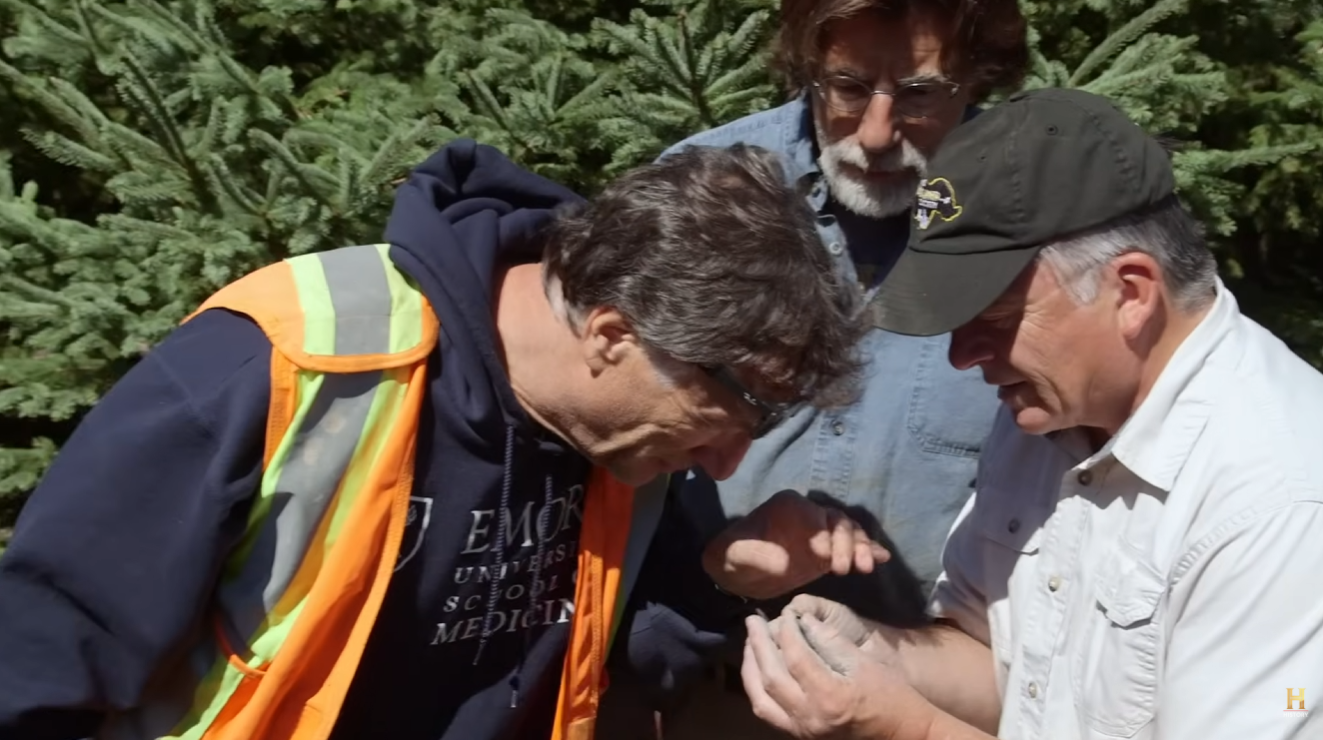
At the same time, activity in the swamp continued to support the theory that Oak Island once hosted a more extensive and organised operation than was previously assumed. In the south-west corner of the swamp, Billy Gerhardt uncovered further sections of a sand-covered cobblestone road, while the team also identified a pattern of survey stakes, including both eight-sided and five-sided examples. Earlier in the season, similar features had been linked to possible medieval-era work, and the latest discoveries appeared to extend that line further toward the north-west corner of the swamp. Rick Lagina suggested the differing stake forms might point to separate operations or even different periods of use on the island, a detail that fits neatly into the wider theory of repeated, multi-generational activity by connected groups.
Lot 5 also provided a smaller but potentially meaningful development. Marty Lagina and Gary Drayton examined a covered well near the bay, a feature that had apparently received little attention before. While the well itself yielded no immediate detector signals, Gary recovered an iron object nearby first considered a driven hook and later possibly a pintle, a pivot pin used in doors or gates. Emma Culligan’s early assessment suggested it dated to before the 1800s, probably the mid-1700s, which may indicate the well is older than previously assumed. That matters because it adds yet another overlooked feature to a growing list of places on the island that may have been dismissed too quickly in earlier decades of searching.

Taken together, the episode felt less like a simple continuation of the treasure hunt and more like a widening archaeological map of Oak Island itself. The team is no longer focused solely on whether treasure lies beneath one point in the Money Pit. Instead, the evidence now seems to suggest a coordinated landscape of roads, markers, wells, stone structures and possible shafts, each hinting at deliberate planning over a long period of time.
That broader picture may ultimately prove just as important as any single discovery of gold or silver. If Peacock 1 confirms a man-made chamber, and if Lot 8 yields a shaft beneath the cradle structure, season 13 may be remembered not simply for another step toward treasure, but for sharpening the case that Oak Island was once the site of a complex engineered operation whose scale is only now beginning to come into focus.
