The Curse of Oak Island season 13 has taken Rick Lagina and the team into one of the most ambitious stages of the Money Pit search, with the Karma 1 caisson reaching 212 feet below the surface.
That depth is being treated as a major moment in the island’s long history. After more than two centuries of searching, the team had pushed deeper than any previous drill, shaft, machine or human-led excavation in the Money Pit area. But instead of ending the mystery, the result raised a new question: could the real target still be even deeper?
This season, Rick ordered three separate seven-foot-wide caisson shafts into the Money Pit zone, creating one of the most aggressive excavation programmes the team has ever attempted. The first shaft, TPF 1, ran into trouble almost immediately when it seized at around 25 feet, apparently blocked by compacted backfill gravel left behind by earlier searchers.
Rather than seeing the setback as failure, Rick treated it as a possible redirection. That delay led the team slightly northwest, to a new target they named Karma 1. The name reflected Rick’s belief that the obstacle may have pushed them toward the right place.
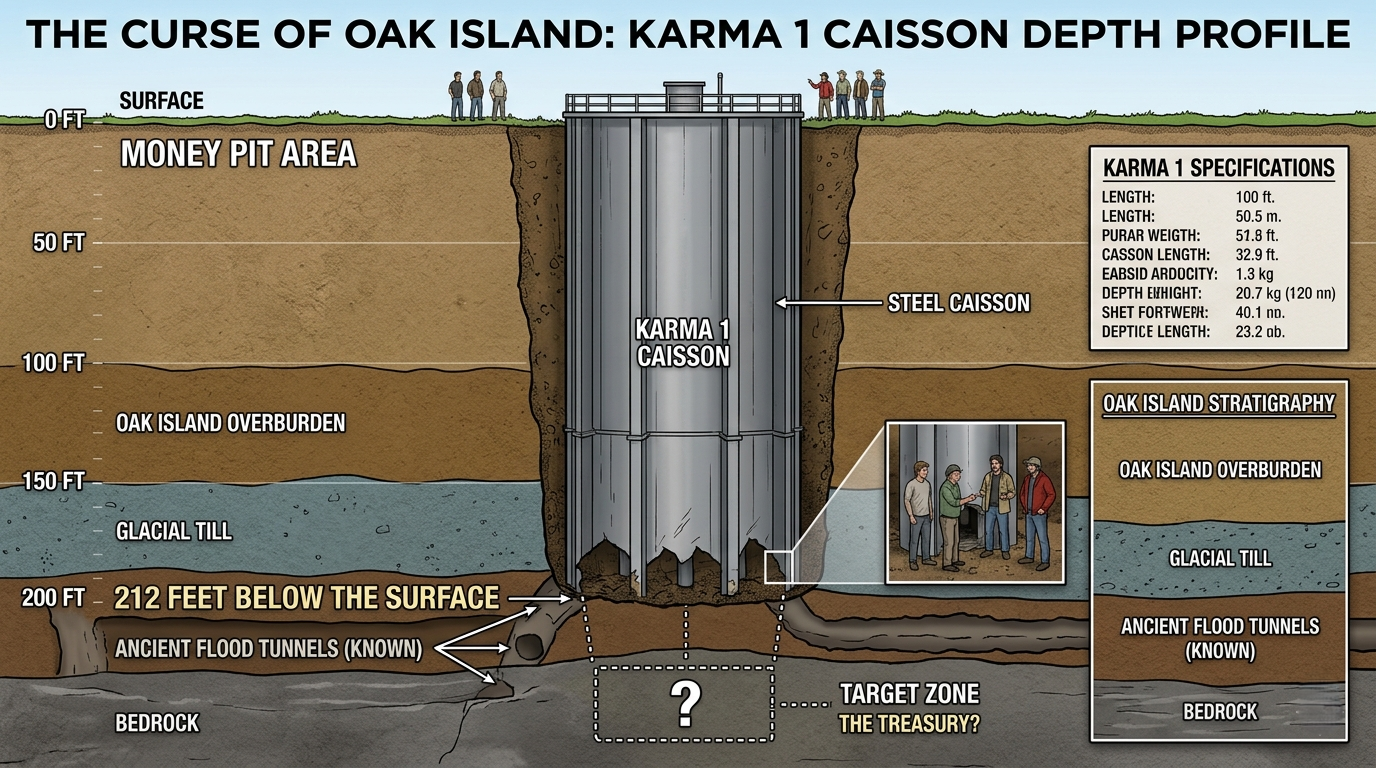
Karma 1 eventually reached its full depth of 212 feet, making it the deepest successful excavation in the history of the Oak Island search. Material recovered from that depth quickly drew attention. Aaron Barkhouse spotted what appeared to be a rosehead spike, while Charles Barkhouse identified it as hand-forged iron that could date to the 1600s or earlier.
For the team, the importance was not only the artifact itself, but its depth. A hand-forged object recovered from so far below the surface raises fresh questions about whether original construction material could still remain deep beneath the Money Pit.
The investigation then shifted to a more data-led target. Geoscientists Dr Ian Spooner and Dr Fred Mitchell proposed a location based on underground water and soil testing that showed high concentrations of silver and gold. That target was named MS1, standing for Mitchell-Spooner.

Unlike the deeper Karma 1 dig, bedrock at MS1 was believed to sit around 160 feet. When drilling began there, the team encountered a hard obstruction between 140 and 150 feet. After breaking through, possible adze-cut wood was found among the spoils.
That depth matters because it is close to the level where William Chappell and Frederick Blair reportedly drilled through what they believed was a cement vault in 1897. The combination of a hard obstruction, possible cut wood and strong silver and gold readings gave the team one of its most focused Money Pit targets in years.
Season 13 also moved beyond Oak Island itself, exploring a possible Portuguese connection. Doug Crowell, Emiliano Sacchetti and Judy Rudebusch presented research linking the island to the Order of Christ, the successor organisation to the Knights Templar.
One key piece of evidence was a corroded Portuguese coin reportedly found in the Money Pit in 1849. The coin was linked to the reign of King Ferdinand I, who ruled from 1367 to 1383. His death triggered a political crisis in Portugal, which some researchers believe may have created a reason for valuable items to be moved to a safer location.
The team also revisited stone shots found on Oak Island. Professor Robert Reese of Acadia University reportedly suggested that some could have originated in the Azores and may date to the 1300s or early 1400s. That finding strengthened the idea that people with maritime knowledge and armed protection may have reached the island far earlier than expected.
The Azores expedition became an important part of the season’s wider argument. By taking Oak Island artifacts across the Atlantic for examination, the team hoped to see whether evidence from both locations could point to the same historical network.
Karma 1 did not bring up a final vault at 212 feet. But Oak Island rarely provides complete answers in one moment. Instead, the team now has a deeper excavation record, a stronger geochemical target, possible cut wood near a historic depth, and renewed links to the Atlantic world.
Season 13 has therefore become less about a single find and more about narrowing the search with unusual precision. Whether the answer lies below 212 feet, near the MS1 obstruction, or elsewhere in the Money Pit remains unknown.
But after 231 years of searching, The Curse of Oak Island may have pushed the investigation closer to the question that matters most: not whether something extraordinary was built beneath the island, but whether the team is finally closing in on where it was hidden.
