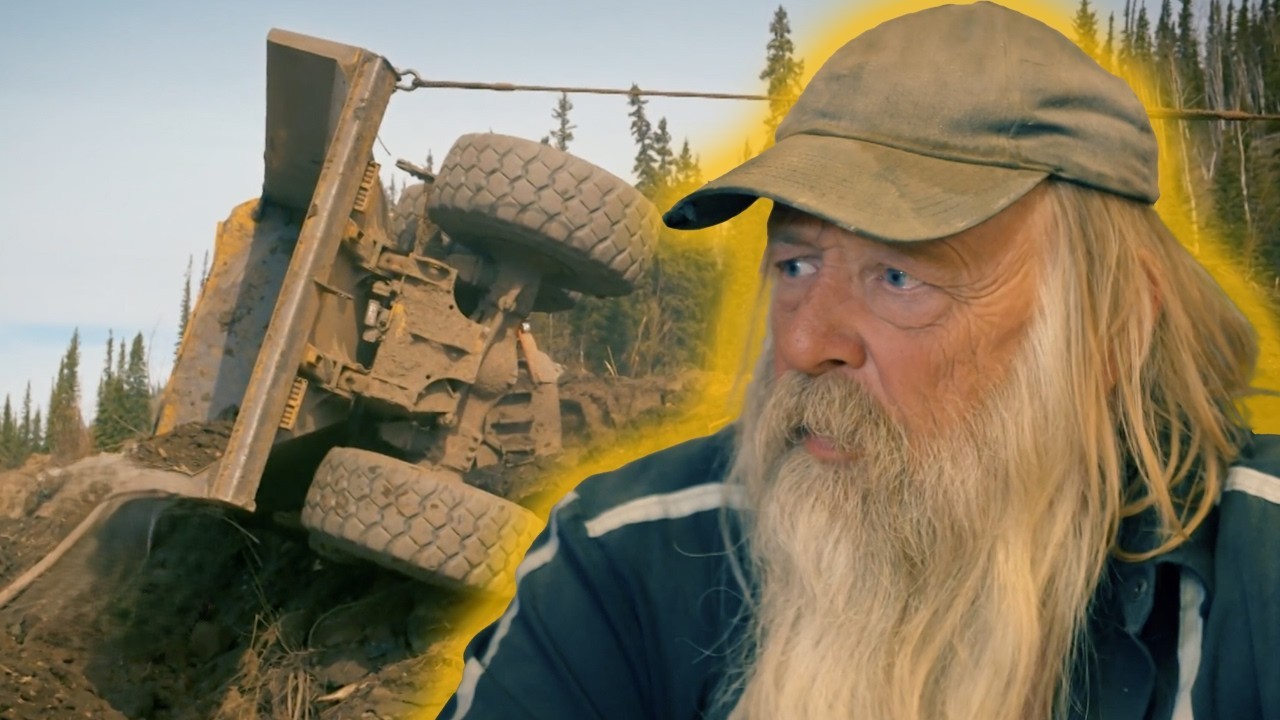
At Tony Beets’ Indian River operation, a week of high expectations quickly spiraled into a costly and chaotic reminder of just how unforgiving Yukon mining can be. In a dramatic sequence of incidents, two rock trucks—each valued at roughly $300,000—were overturned within the same working week, bringing production to a halt on multiple occasions and exposing the risks of relying heavily on an inexperienced crew in unstable ground conditions.
The Early Bird cut extension, designed to rapidly open new pay and sustain feed to the wash plant, has instead become the focal point of operational disruption. What was intended to be a controlled expansion has turned into a high-pressure test of both machinery and manpower, with Tony once again leaning on a large influx of new recruits to keep operations moving.
A WEEK THAT SPIRALED OUT OF CONTROL
The first incident occurred when rookie rock truck driver Sam Moore, still relatively new to the realities of Yukon mining, attempted to navigate the soft, shifting terrain of the cut under load. The ground beneath the truck gave way unexpectedly, causing the massive vehicle to tip and settle awkwardly into the bank.
The flip immediately triggered a chain reaction across the site. Equipment was frozen in place as operators assessed the situation, with heavy machinery operator Jacob Moore called in to execute a recovery operation. Using a large excavator, the crew carefully emptied the truck’s box and coordinated a controlled recovery, successfully bringing the machine back onto its wheels. Although no serious injuries were reported, the incident halted hauling operations and exposed the instability of the newly stripped ground.

But the week was far from over.
SECOND FLIP SHOCKS EVEN EXPERIENCED HANDS
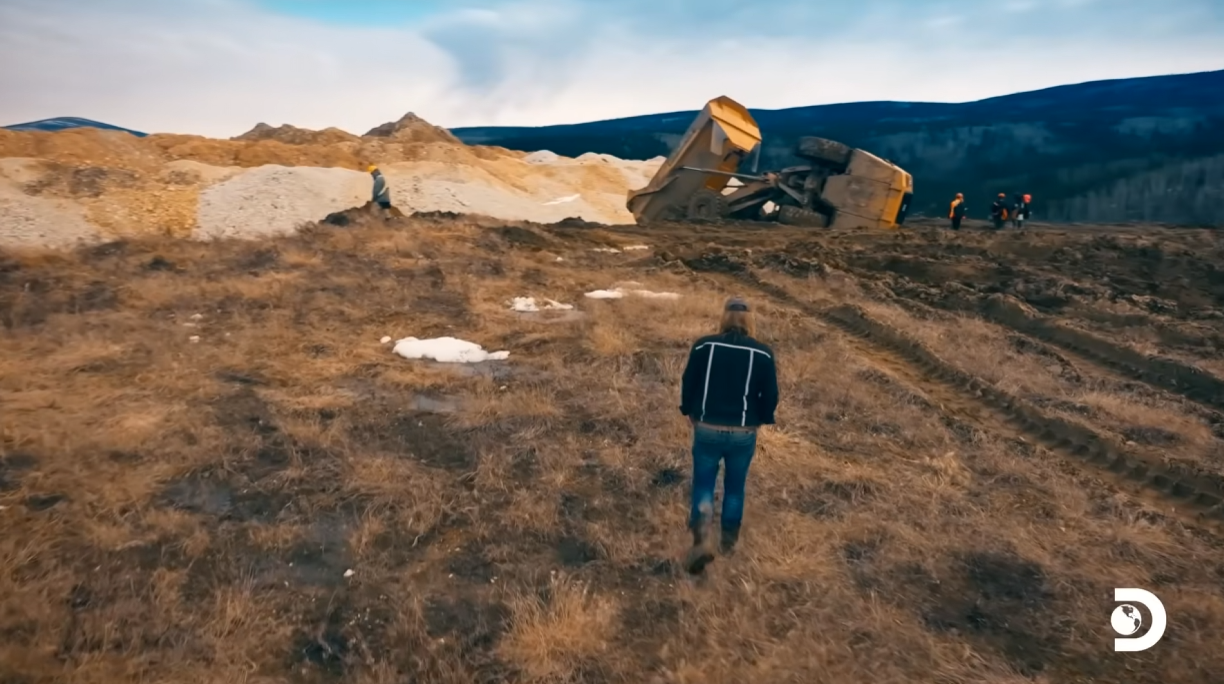
In a turn that surprised even seasoned crew members, a second rock truck was later overturned under similar conditions in the same working zone. This time, the operator involved, Mason McIntyre, had more experience than the first driver—but even that was not enough to counter the unpredictable softness of the cut.
As the truck sank and rolled, production once again ground to a halt. The same recovery protocol was deployed, with excavators brought in to stabilize the area and carefully remove material from the overturned box before attempting to right the vehicle.
The repeated failures highlighted a growing concern: the Early Bird extension ground is not behaving as expected. What should have been a straightforward strip-and-haul operation has instead revealed inconsistent substrate conditions, increasing the likelihood of equipment instability.
“THROW THEM IN AND SEE IF THEY SWIM”
Tony Beets’ approach to staffing is well known across the Yukon mining scene. With the arrival of roughly 40 new workers this season, the strategy once again emphasized rapid onboarding and immediate deployment into active operations.
For Beets, the philosophy is practical rather than theoretical—new recruits are placed directly into real mining conditions and expected to adapt quickly. However, the events of this week underscore the limitations of that approach when paired with soft ground, high-value equipment, and aggressive production timelines.
While some crew members have begun to adapt, the learning curve has proven steep. Rock truck operators in particular have been placed under intense pressure, navigating narrow haul roads, unstable banks, and rapidly changing cut geometry.
OPERATIONAL PRESSURE MOUNTS
Beyond the immediate equipment damage, the broader concern for Tony Beets is production continuity. The Early Bird cut is not just another excavation zone—it is the critical feed source for ongoing gold recovery operations. Any disruption in haulage directly impacts the wash plant, reducing throughput and threatening seasonal targets.
With two major equipment recoveries required in a single week, downtime has accumulated at a pace the operation can ill afford. Each stalled truck represents not only repair and recovery effort, but also lost movement of pay dirt during a narrow seasonal window.
Despite the setbacks, Beets and his team have continued pushing forward, with additional excavation work focused on stabilizing the extension and improving haul road conditions. The goal remains unchanged: expand quickly, stabilize the ground, and restore consistent material flow to the plant.
A HARSH LESSON IN YUKON REALITY
For veteran operators, incidents like these are not entirely unexpected. Yukon placer mining is defined by volatility—both in geology and human performance. Even experienced drivers can be caught out by hidden soft spots, waterlogged seams, and sudden slope failures.
However, the clustering of two major truck flips in such a short period has intensified scrutiny on site planning and ground assessment practices. It also raises broader questions about the balance between rapid expansion and operational safety in high-output mining environments.
LOOKING AHEAD
As the dust settles on a turbulent week at Indian River, Tony Beets faces a familiar challenge: restore control, rebuild momentum, and push forward despite setbacks that would stall lesser operations.
The Early Bird extension remains central to the season’s success. But unless ground stability improves and new drivers adapt quickly to the harsh realities of the cut, the cost of progress may continue to climb—both in equipment and in lost time.