For centuries, Oak Island has teased treasure hunters with promises of unimaginable riches—pirate gold, the Holy Grail, or perhaps even Templar secrets. But has the infamous Money Pit finally revealed its secrets in 2025?
Startling discoveries, including hidden pathways in the swamp and a mysterious gemstone found on Lot 5, suggest someone of great wealth visited long before anyone knew the pit existed. Could these clues finally unravel the island’s legendary mystery—or are we once again chasing shadows? The truth may be closer than ever, hidden in secrets the island has guarded for centuries.

The Money Pit Origins: The 1795 Discovery
The story begins in 1795, on a quiet tree-covered speck in Nova Scotia’s Mahone Bay. Three teenagers—Daniel McGinnis, John Smith, and Anthony Vaughn—stumbled upon a curious depression beneath an oak tree. A pulley system hung above and freshly cut trees lay nearby. At just two feet down, they struck flagstones. At ten feet, a log platform. Then again at twenty, thirty—each layer fueling dreams of pirate gold.
By 1804, the Onslow Company continued the dig, uncovering a stone slab inscribed with mysterious symbols said to translate: “40 feet below, 2 million are buried.” But then the shaft flooded—a trap seemingly designed to protect whatever lay beneath.
Was this the work of pirates? Templars? French nobility? The engineering pointed to deliberate design. Later discoveries—non-native coconut fiber, logs, and strange stones—only added fuel to the fire.
Centuries of Searching: Historical Expeditions
From the Truro Company in 1849 to the Oak Island Association in 1861, the hunt grew more intense and tragic. A pump explosion in 1861 killed one worker—the first of six who would die, birthing the legend: seven must perish before the treasure reveals itself.
In 1909, a young Franklin D. Roosevelt joined a salvage effort. Later, the 1930s saw William Chappell find gold flecks at 153 feet, though funds dried up before excavation could continue. In 1965, Robert Restall and his team explored Borehole 10X—then tragedy struck again. Carbon monoxide killed Restall and three others.
Still, strange finds emerged: a 17th-century Spanish coin, parchment fragments, and even a Roman-style stone. Coconut fibers—foreign to Nova Scotia—kept the mystery alive.
The 2025 Breakthrough: Swamp Pathways
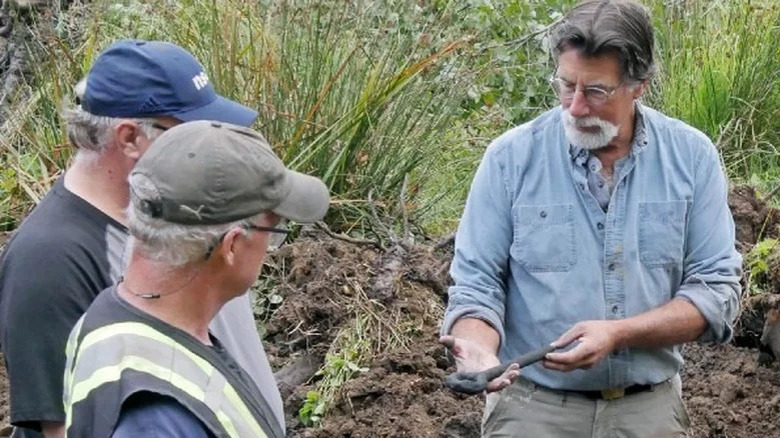
Season 12, Episode 15 of The Curse of Oak Island, titled “Channeling the Solution,” aired on March 11, 2025. The Lagina team uncovered a massive stone-lined network beneath the swamp—once a cove 800 years ago. These weren’t natural formations. They were engineered routes, possibly for moving treasure from a ship docked in the swamp to hidden locations.
Core samples dated saltwater intrusion to the 1300s–1400s, aligning with Templar theories. A charred, stressed wooden barrel fragment—carbon dated to the 15th century—was recovered, possibly from a destroyed vessel.
The Gemstone Discovery on Lot 5
Then came a shocker: a professionally cut, high-quality gemstone found on Lot 5. Not an everyday loss—this belonged to someone important. Its medieval craftsmanship pointed to knights, pirates, or nobles.
Gemologists dated it possibly pre-Columbian, suggesting European or Middle Eastern origin. The reaction from Rick and Marty Lagina was telling: this was no accident. It was part of something much larger.
The Lead Cross Re-examined
Originally discovered in 2017, the lead cross from Smith’s Cove gained new relevance. In 2025, isotope testing traced it to a mine in southern France—Templar territory. Its design matched known Templar relics. Dated to the 12th–13th century, it pushed Oak Island’s mystery back by 300 years.
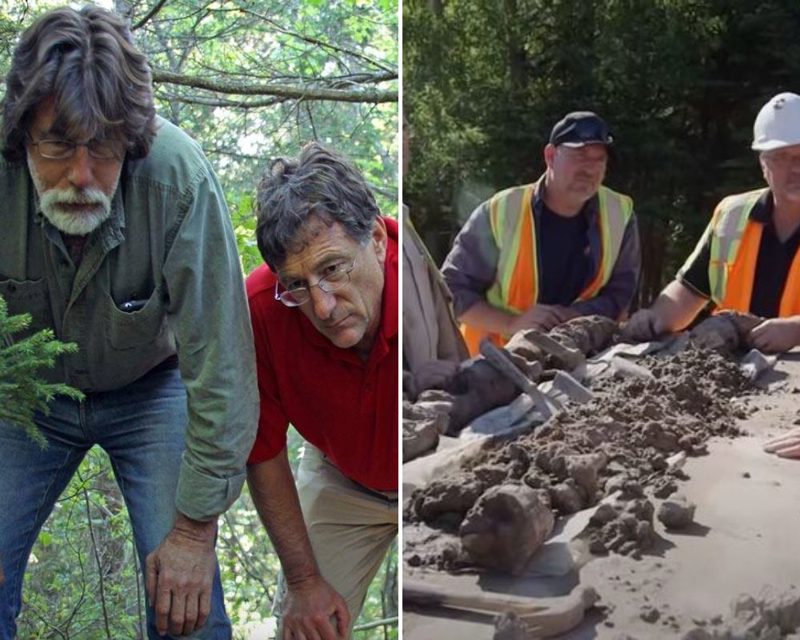
This discovery shifted the narrative. Theories about 18th-century pirates gave way to speculation about the Templars escaping persecution in 1307—possibly bringing their treasure to Nova Scotia.
The Lagina Brothers: Modern Crusaders
Rick and Marty Lagina transformed Oak Island exploration by combining obsession with scientific rigor. Inspired by a 1965 Reader’s Digest article, they teamed up with longtime digger Dan Blankenship in 2006 and brought in ground-penetrating radar, seismic scans, and carbon dating.
They found everything from medieval human bone fragments (European and Middle Eastern) to gold-plated buttons and Roman coins dating to 300 BC. The swamp became central, revealing barrels, stones, and artifacts from centuries before colonial settlement.
Oak Island Goes Global: The History Channel Effect
In 2014, The Curse of Oak Island debuted on History Channel, transforming a Canadian legend into global obsession. Each week, viewers watched real-time discovery unfold, from drilling to dramatic artifact reveals.
Narrated with signature mystery—”Could it be…”—the show captivated millions. It wasn’t just a treasure hunt. It was a quest for historical truth, spiritual echoes of the past, and humanity’s eternal hope: that some legends are real.
What Comes Next?
With each new discovery—stone pathways, ancient relics, foreign coins, lead crosses—the island’s secrets grow deeper. The team isn’t just chasing gold. They’re uncovering history rewritten.
The question now isn’t if Oak Island holds something monumental. It’s what exactly was buried here—and why. Was it sacred treasure? A fleeing order’s final act? Or a riddle left to outlive its creators?
One thing is certain: Oak Island has not given up all its secrets—but in 2025, it’s whispering louder than ever.