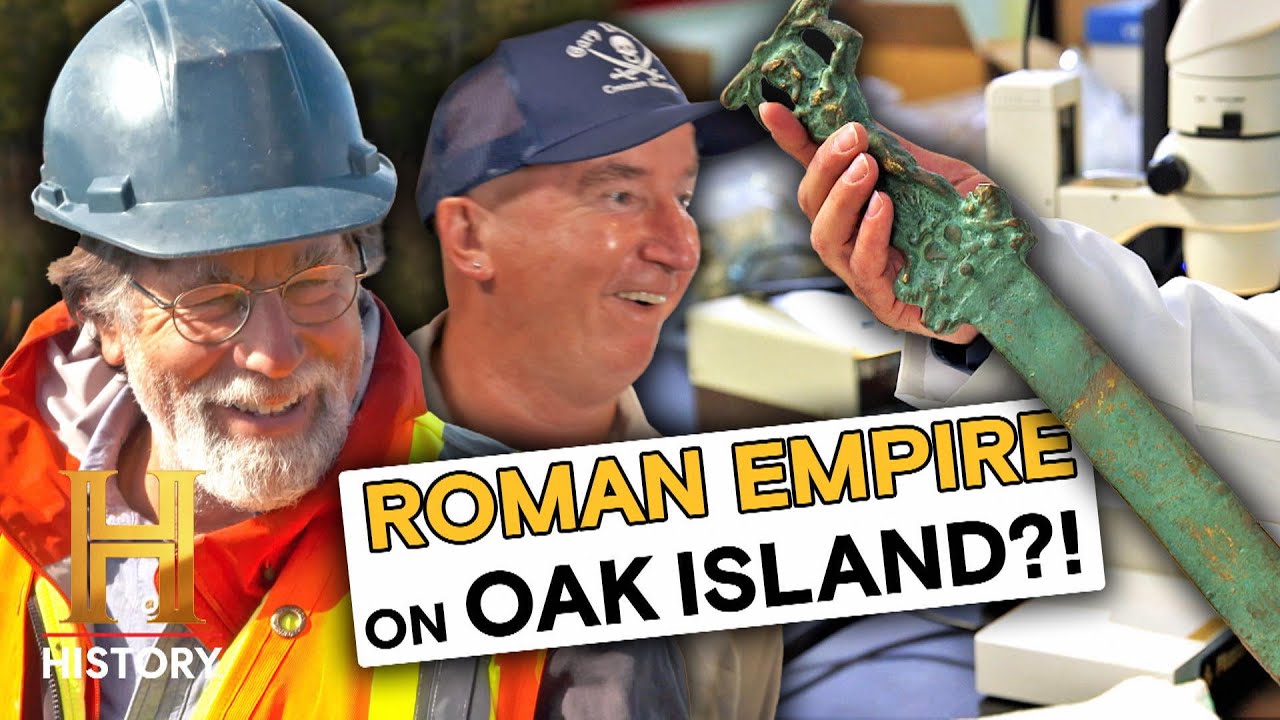
As a new week begins in the ongoing search for treasure on Oak Island, the Lagina brothers and their team make significant discoveries that could reshape the historical narrative of the region. This time, the team investigates a mysterious Roman sword and an ancient coin that may predate the 16th century, deepening the intrigue surrounding Oak Island’s past.
The Roman Sword: Fact or Fiction?
Rick and Marty Lagina, along with their son Alex, Craig Tester, and Dave Blankenship, travel to St. Mary’s University in Halifax to examine an object resembling an ancient Roman sword, reportedly found in the waters off Oak Island. They consult Professor Myles McCallum, an expert on Roman archaeology, in the hope of authenticating the artifact.
Upon closer inspection, McCallum expresses skepticism. The sword appears to be cast using a bivalve mold rather than the lost-wax technique typical of genuine Roman craftsmanship. He concludes that it is unlikely to be an actual Roman relic but speculates it may be a historical replica dating from the 18th or 19th century. If true, the artifact could still hold significance, potentially linking Oak Island to early European explorers.
A Roman Coin on Oak Island?
Meanwhile, at the Oak Island Interpretive Center, numismatist Sandy Campbell examines a cut copper coin discovered by Rick Lagina and Gary Drayton on Lot 5. X-ray fluorescence (XRF) analysis reveals a composition of copper, lead, tin, and traces of arsenic and silver an elemental makeup consistent with coins predating the 16th century.
Upon further inspection, Campbell determines that the coin’s design and inscription resemble Roman or possibly Byzantine currency, dating back to approximately 300 BC–600 AD. The revelation electrifies the team, prompting speculation about whether ancient Roman or Mediterranean explorers may have visited Oak Island centuries before European colonization.
Links to the Knights Templar and Portugal?
The discovery of a Roman-era coin reignites discussion about Oak Island’s possible connections to the Knights Templar. The team recalls their previous expedition to Portugal, where they studied Templar sites and Roman-era infrastructure that closely resembled the stone pathway found in Oak Island’s swamp. Could the presence of Roman artifacts suggest an even deeper historical connection between Oak Island and Old World civilizations?

A 15th-Century Horseshoe Adds to the Mystery
As excavation efforts continue in the swamp, Rick Lagina, Gary Drayton, and Billy Gerhardt uncover a small, heavily corroded horseshoe. The artifact is analyzed by blacksmithing expert Carmen Legge, who determines that the horseshoe dates back to the 1400s and was likely used for a cavalry or riding horse.
The discovery raises an intriguing question: Who brought a riding horse to Oak Island centuries ago? Given that all animals would have been transported by ship, the horseshoe could further support the theory that early European or even pre-Columbian visitors set foot on the island.
What’s Next?
With new clues emerging, the team is eager to continue their excavation on Lot 5 and in the swamp, hoping to uncover more links between Oak Island and ancient maritime explorers. The presence of potential Roman artifacts, along with the Knights Templar connection, fuels their determination to unravel the island’s centuries-old mystery. As the search continues, the treasure hunters remain hopeful that they are closer than ever to discovering Oak Island’s long-lost secrets.
Stay tuned as the Oak Island team pushes forward in their relentless pursuit of the truth.