
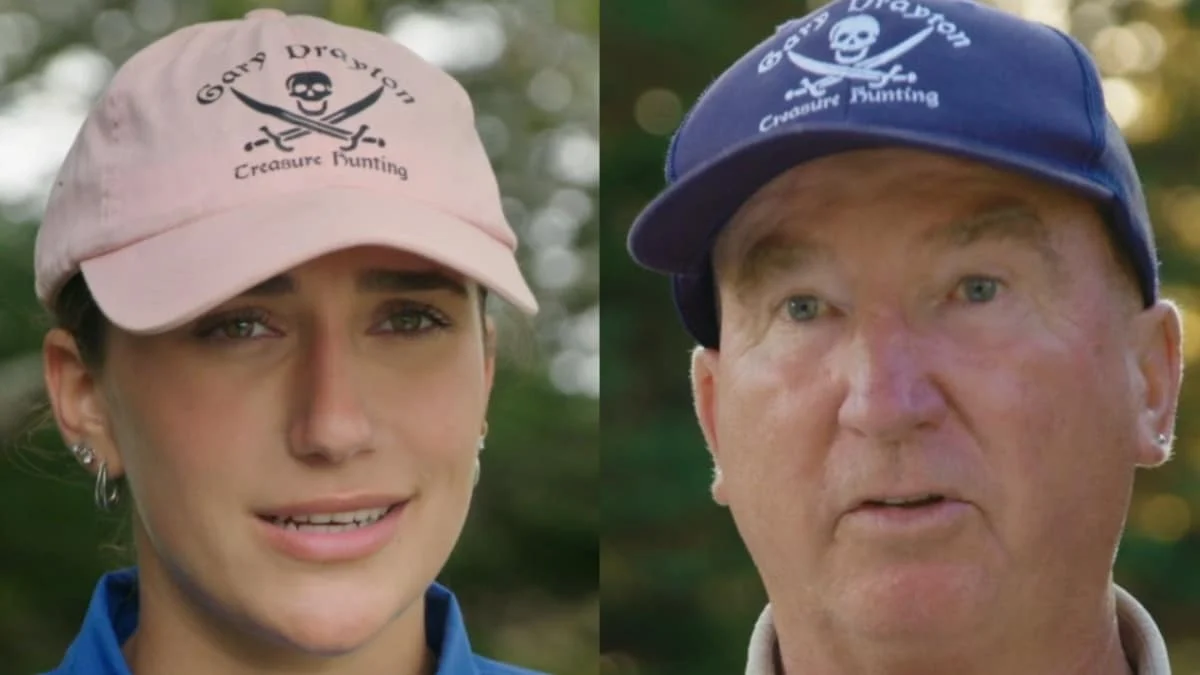
A new chapter has begun on Oak Island, and it’s being written not by seasoned veterans, but by a young woman making her first serious dig. Katya Drayton, daughter of metal-detecting expert Gary Drayton, has unearthed critical new evidence in one of the island’s most enigmatic areas: Smith’s Cove.
What began with a simple excavation quickly turned historic. Katya unearthed a centuries-old wooden beam, possibly linked to the legendary underground tunnel system that has obsessed treasure hunters for over two centuries. The discovery wasn’t accidental. Katya was assigned to dig alongside long-time team members Craig Tester and Jack Begley—without the help of her father—showing the team’s confidence in her abilities. Her efforts yielded more than symbolic success.
Katya’s first artifact was a large, rusted iron object—likely centuries old—buried deep beneath the surface. But it was what came next that truly shook the team. A thick, shaped piece of wood, broken at one end, resembling support beams used in tunnel construction, was pulled from the depths of Smith’s Cove. The discovery reinvigorated the team’s efforts, prompting new scans of the area in hopes of revealing further connections to the original Money Pit complex.
FROM FRANCE TO NOVA SCOTIA: THE MYSTERY OF THE LEAD CROSS
Shortly after Katya’s discoveries, attention returned to a puzzling artifact: the infamous lead cross found near Smith’s Cove. Initially dismissed by some as an anomaly, new forensic analysis has revealed its lead composition originated from a narrow region in southern France—specifically near the ancient village of Rennes-le-Château, a place long associated with Templar legends and hidden treasure.
The cross, dated to before the 15th century, closely resembles symbols carved into the walls of a medieval French prison where imprisoned Knights Templar etched symbols to preserve their faith. The implication is staggering: could a Templar artifact have been carried across the Atlantic, centuries before Columbus?
Adding weight to the theory, a heavy iron spike—larger than any railroad spike—was recovered from Lot 32, near the island’s southern edge. The spike, likely used for securing large loads, dates to between 1710 and 1740. That same lot once produced a cargo seal, suggesting organized trade—or smuggling—was taking place.
Further deepening the intrigue, a long-forgotten 1746 French ship’s log recently surfaced. It details a failed mission to reclaim land from the British and hints at the offloading of “significant treasure” to a remote island—a treasure hidden in a deep pit and connected to a beach by tunnel.
THE STAR MAP THEORY: TAURUS OVER OAK ISLAND
As history unfolded underground, the skies may have held their own secrets. A scientist studying constellations proposed that the shape of Taurus the Bull maps almost perfectly onto Oak Island and surrounding islets. When laid atop the local geography, key stars aligned with prominent land features—triangular stones, isolated boulders, and other markers long assumed natural.
Each alignment coincided with significant dig sites or unexplained anomalies, further fueling speculation that whoever designed the island’s mysterious layout did so using celestial maps—perhaps even using the stars to mark hidden vaults or passageways.

THE LAB OF TRUTH: EMMA CULLIGAN’S SCIENCE SHIFTS THE SEARCH
No stranger to Oak Island, lab analyst Emma Culligan returned to test a corroded coin recovered from Lot 5. Her scan revealed a composition of 70% copper and 16% lead, inconsistent with modern currency but matching the alloy blend of Roman-era coinage, dating potentially to the 3rd century.
Emma’s work has grown essential to the operation. Her analyses guide excavation zones, validate artifact timelines, and challenge or confirm long-standing theories. Fans have dubbed her the “voice of reason” amid the swirl of legends, anchoring the hunt in scientific rigor.
Her latest scan has once again shifted focus. Lot 5 is now considered a high-priority area. And with a new shaft recently discovered near the Money Pit, Emma’s lab is poised to determine whether it’s just another false lead—or the long-lost entrance to something monumental.
THEORY OR TRUTH? A TAPESTRY OF CLUES EMERGES
The cross.
The coin.
The iron spike.
The ship’s log.
The carved prison walls.
The French nobleman.
The constellation map.
Individually, each element could be coincidence. Together, they form an unnerving consistency—a centuries-spanning pattern that may finally connect European history, ancient symbols, and the buried architecture of Oak Island.
Whether it’s the Knights Templar, ancient Roman explorers, or 18th-century smugglers who hid something of value on this remote Nova Scotian island, one thing is clear: the story is far from over.
And now, with the next generation—Katya Drayton—taking up the tools, the dig continues.
