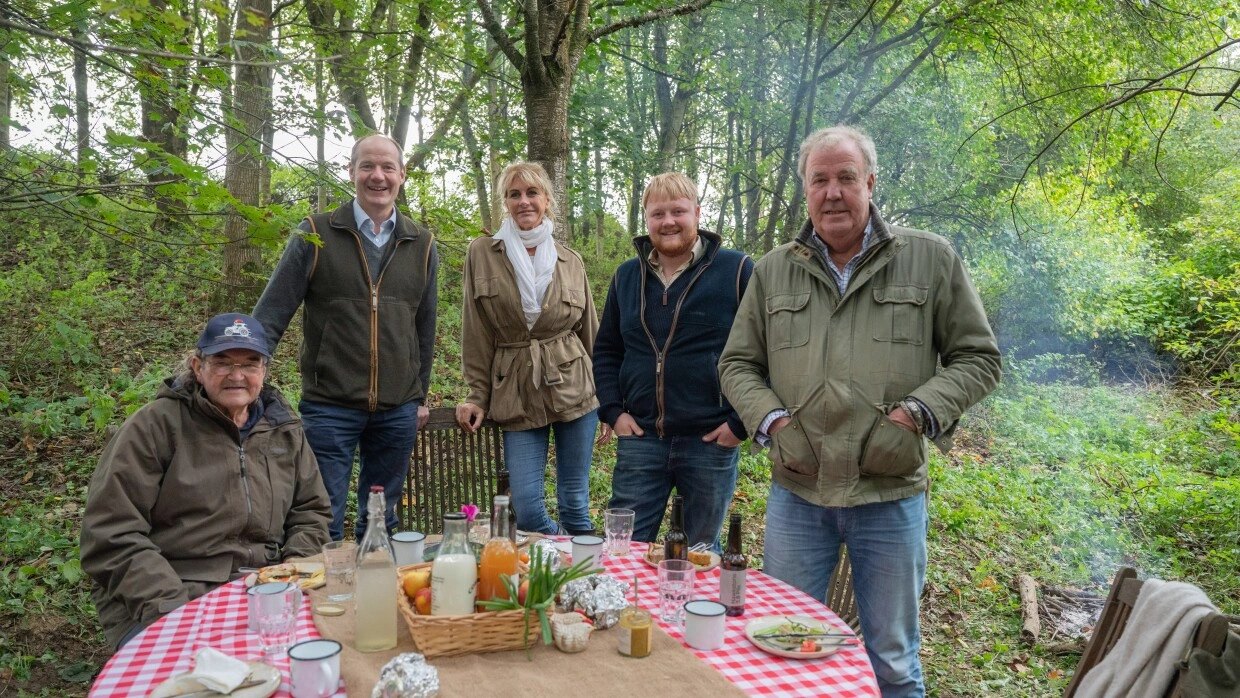
By its fifth season, Clarkson’s Farm has evolved from a chaotic celebrity experiment into a fully functioning farm attached to a pub, shop, restaurant, and livestock operation. What once was a humorous struggle against nature and machinery has now become a complex enterprise balancing livestock, tourism, and merchandise.
Season 5 opens with a jolt: Jeremy Clarkson in hospital after a serious heart scare. This early event casts a new fragility over the series. Clarkson remains theatrical, loud, and prone to overconfidence, but the show now accounts for the human vulnerability behind the persona. The farm’s expansion—complete with public demand, logistical headaches, and a shop where patrons sometimes steal glasses—adds pressure beyond the usual comic mishaps.
Clarkson’s charisma still drives the series. His gift is transforming mundane farming tasks—soil analysis, cattle checks, and tax challenges—into dramatic, almost theatrical moments. Kaleb Cooper, with his practical, grounded approach, often serves as the necessary counterpoint to Clarkson’s impulsive plans. Charlie Ireland provides financial caution, Lisa Hogan introduces entrepreneurial unpredictability, and Gerald injects local humor and folklore. Their presence keeps the show anchored in reality, preventing it from becoming purely a celebrity spectacle.
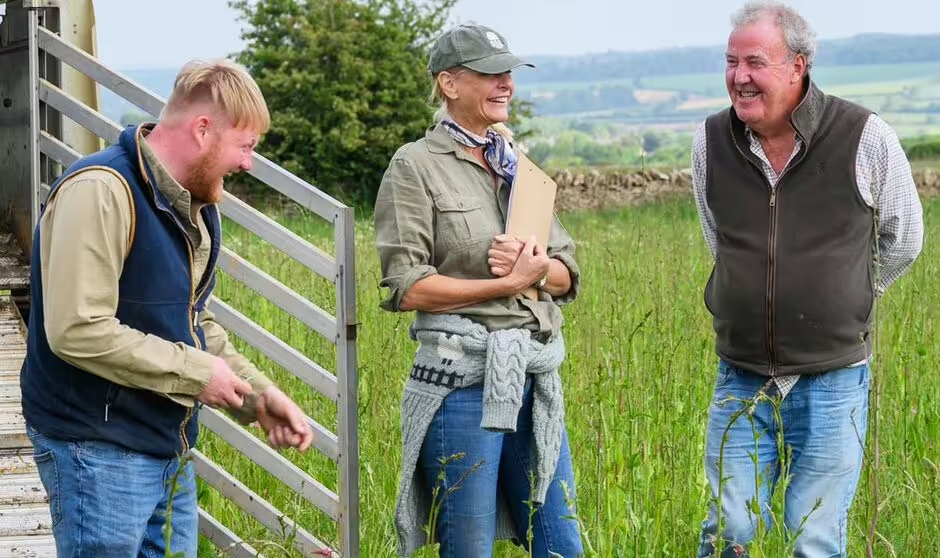
Season 5 excels when it focuses on practical farming challenges. Livestock management provides rich narrative material, particularly when demand from the pub and restaurant intensifies pressure on cattle and pigs. Clarkson’s decision to buy “EasyCare” sheep is emblematic of the season’s mix of humor and education—Kaleb quickly reminds viewers that no sheep are truly easy, highlighting the complexity and unpredictability of farm life. Lisa’s Valais Blacknose sheep, photogenic and costly, underscore a recurring tension: the intersection of farming, lifestyle branding, and social media exposure.
Animal care sequences are often candid and sometimes grim. Pregnancy checks, mortality events, and postmortems maintain the show’s moral grounding, portraying animals as both valued companions and agricultural resources. These moments remind viewers that farming is inherently practical and demanding, with successes and failures weighed equally.
A standout segment features Clarkson and Kaleb visiting a Dutch potato farm. Here, advanced technology—drones, heat maps, soil sensors—illustrates how modern farming is increasingly a high-intelligence endeavor. Clarkson, traditionally a larger-than-life personality, becomes a student again, navigating systems of data, logistics, and engineering. This sequence emphasizes the show’s educational value, blending entertainment with real insights into contemporary agriculture.
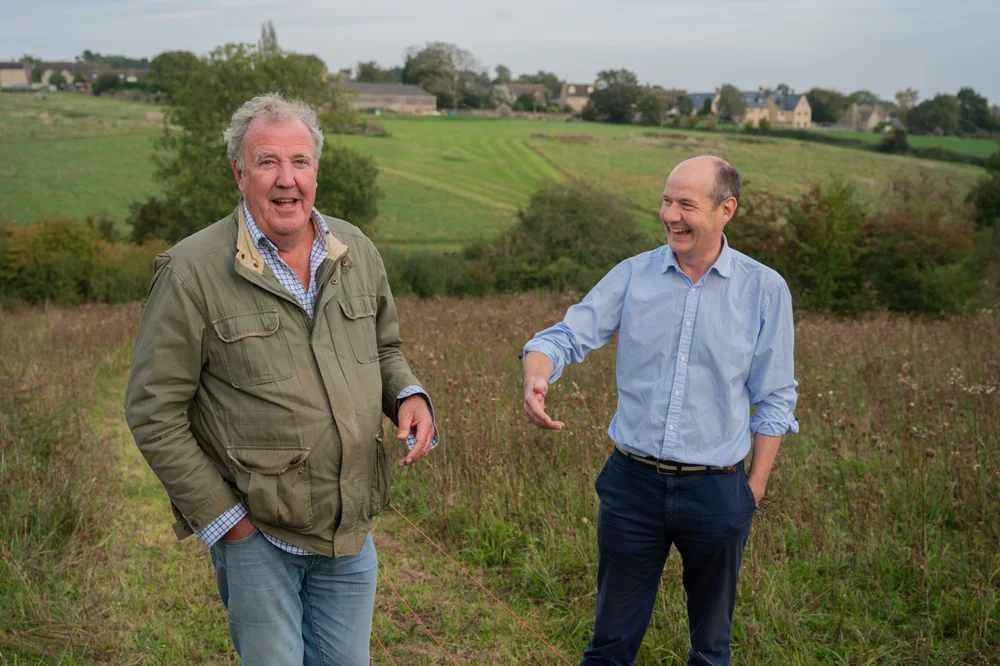
Season 5 also foregrounds the political and economic pressures facing British farmers. Fertilizer costs, energy bills, tax changes, and regulatory hurdles underscore the precariousness of rural livelihoods. Clarkson’s wealth complicates the narrative, yet the series effectively demonstrates how abstract policies translate into daily operational challenges on a farm. Rural life, romanticized by urban audiences, is revealed to be regulated, expensive, and exhausting.
The farmers’ protest storyline adds further weight. Clarkson, by circumstance and camera logic, becomes a public figure for rural frustration, highlighting the tension between comedic spectacle and serious political commentary. The show often balances humor and gravity: stolen glasses or an energy bill provoke laughter but also reflect real-world business fragility. Even something as minor as being told to eat yogurt can reveal the limitations of Clarkson’s once-indestructible persona.
While Clarkson’s Farm is a polished reality production, Season 5 still retains its core authenticity. Guest appearances, infrastructure crises, and hospital sequences are staged for maximum effect, yet the series never loses the grounding presence of the land, animals, and farming tasks. The repetition of Clarkson buying ill-advised equipment and learning hard lessons is familiar but remains effective because the underlying material—the land, mud, livestock, weather, and bills—resists simplification.
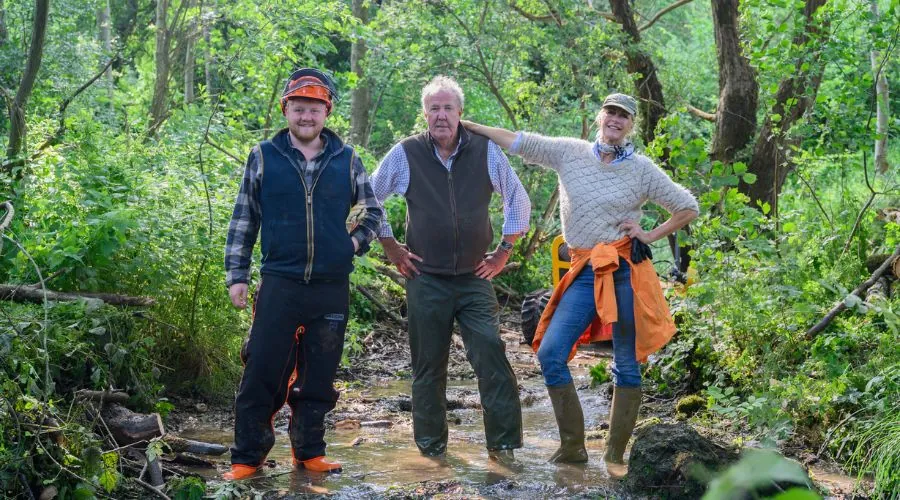
Ultimately, Season 5 is about the collision of fame, farming, and real-world challenges. The series thrives when it foregrounds practical knowledge, allowing viewers to experience the unpredictability, ingenuity, and grit required to run a working farm. Clarkson’s celebrity provides access and humor, but the show’s heart lies in its depiction of a farm that demands respect, adaptation, and hard work.
Even as the series navigates brand management, tourism, and social media attention, it maintains cultural significance by highlighting the realities of agriculture. Season 5 demonstrates that despite wealth, fame, and modern conveniences, the fundamental unpredictability of farming remains. Sheep will act unpredictably, machinery will fail, and weather will challenge even the most prepared farmer.
In blending comedy, education, and human vulnerability, Clarkson’s Farm continues to entertain while subtly instructing audiences about the complexity of contemporary farming. Season 5 is a reminder that no matter the size of the tractor, the pub, or the celebrity, the land and animals remain sovereign, often humbling even the most famous of farmers.
