
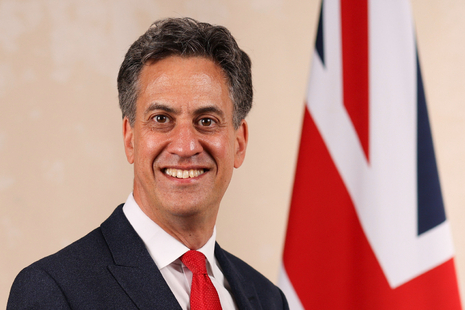
The drive toward net zero in the UK may seem like a noble pursuit, but for many British farmers, it’s nothing short of a death sentence. Ed Miliband’s project, which aims to reshape the future of farming, is being viewed by some as an attack on the very heart of rural Britain. While Miliband and other policymakers in Westminster may have never stepped foot in a muddy field, they are nonetheless dictating the future of a sector that relies on real-world conditions – conditions that do not bend to the whims of government policies.
As climate change becomes a central theme in agricultural policy, farmers are left to face the reality of unpredictable weather, rising costs, and the constant pressure to innovate without being given the tools to do so. The move toward electric tractors, for example, has garnered significant attention. While the intention may be to reduce emissions, the reality on the ground is far different. Farmers who depend on machinery that can run for long hours during critical times of the year face a dilemma when electric tractors, with their limited battery life, fall short. For farmers, there is no pause button. If a tractor breaks down during harvest, the crop is lost. The promise of a green future cannot replace the immediate demands of farming.

The real danger lies in the net zero targets, which, as currently enforced, will reduce domestic farming production in favor of imported goods. This isn’t about reducing emissions; it’s about relocating them. With stricter environmental regulations in the UK, it becomes more cost-effective to import food from countries with weaker environmental standards. As a result, the UK is trading in self-sufficiency for an overreliance on international supply chains. The irony is harsh: domestic emissions may drop on paper, but the carbon footprint of imported food rises as it travels across the globe.
The cost of net zero is not just financial; it’s personal. British farmers, who have invested in cleaner technologies and worked hard to comply with every regulation, are now seeing their competitiveness erode. Meanwhile, policies continue to benefit those who can afford to sidestep the strict regulations and import food at a fraction of the cost. The farmers who have tried to do the right thing are being punished, while those who fail to follow through are left unscathed.
But the consequences of policy failure extend beyond the economy. If the net zero strategy fails, it’s the farmers who bear the brunt of the loss. When a policy fails in Westminster, the government can launch another review or consultation, and life goes on. But for farmers, a bad season means the loss of their livelihood. A broken machine, an unpredictable drought, or the wrong weather at harvest time can mean the end of a farm that’s been in the family for generations.

Farming doesn’t have the luxury of time to wait for promises of future technological breakthroughs. When machinery fails or weather turns, farmers have no choice but to adapt and make do with what they have. There’s no waiting for the technology to catch up. And there’s no second chance. A bad season can wipe out years of hard work, and when that happens, the farm disappears, often without a sound. Once land is sold or skills are lost, they are rarely replaced.
The policy shift toward net zero is, in essence, a redesign of agriculture itself. Small farms, family farms, and independent operations are already feeling the pressure. Compliance costs rise, margins shrink, and the demands of new regulations push these farmers to the brink. Eventually, only the large, heavily capitalized farms will survive, or the food production will shift abroad entirely. This may look efficient on paper, but it creates a fragile system, dependent on global trade routes and vulnerable to unforeseen disruptions.
In the end, this isn’t about saving the planet – it’s about the elimination of traditional farming. As food production becomes increasingly centralized and removed from the land, British food security becomes more tenuous. The irony is that the very policies designed to reduce carbon emissions may, in fact, be making the situation worse. Net zero, as it is enforced, isn’t about cleaner farming; it’s about deciding who gets to farm at all.
The loss of farming knowledge, experience, and self-sufficiency is a cost that cannot be measured in emissions alone. It’s a cost that goes beyond economics. It’s about losing the people who know how to work with the land, who understand the weather, and who have the judgment to make decisions based on years of experience. Once that knowledge is gone, it cannot be replaced by policy or technology.
This isn’t an argument against caring for the environment. But it is an argument against pretending that reality can be rewritten on paper. Farmers live in the real world, where weather, time, and risk are constant companions. Ignoring these realities is not only dangerous for farming but for the future of food security in Britain. The policies that are supposed to lead us to a cleaner, greener future are instead creating a future where food is less reliable, less local, and less secure. And that, ultimately, is the true cost of net zero.
If you care about the future of farming and food production in the UK, it’s time to start asking tough questions. This isn’t just a policy issue; it’s a survival issue. And if we don’t recognize the costs, the results will be disastrous for us all.
