When Deadliest Catch first aired in 2005, it wasn’t just another reality show — it was a storm at sea, bottled and broadcast. It captured something primal: men risking their lives for survival and pride on the brutal waters of the Bering Sea.
But two decades later, Discovery Channel’s once-revered series has drifted far from its roots. What began as a raw documentary about danger and brotherhood has devolved into a saga of lawsuits, scandals, and scripted tension.
Now, fans are asking: What really happened to Deadliest Catch — and can it ever be saved?
The Show That Redefined Reality TV
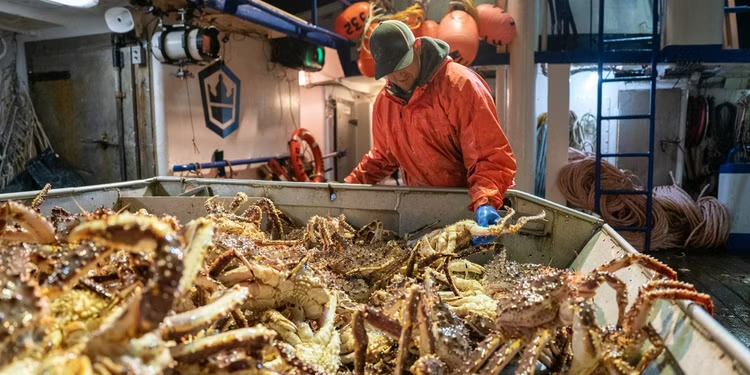
When Deadliest Catch premiered, it felt revolutionary. The formula was simple but electric: harsh weather, exhausted fishermen, and the kind of danger no producer could fake.
The setting — Dutch Harbor, Alaska — looked less like a filming location and more like the edge of the world. Captains Sig Hansen, Phil Harris, and the Hillstrand brothers weren’t actors. They were working men with nicotine-stained fingers and thousand-yard stares.
Audiences were mesmerized. By its third season, Deadliest Catch drew more than 3 million viewers per week, airing in 170 countries and earning multiple Emmy Awards.
“It was the perfect storm,” one former producer recalled. “No scripts, no glamour — just men versus the sea.”
The First Cracks in the Hull
The show’s authenticity began to fracture in 2010, when Discovery Channel sued the Hillstrand brothers for $3 million over a failed spin-off, Hillstranded. The brothers refused to film additional footage; Discovery fired back with legal threats.
Captain Sig Hansen sided with the Hillstrands, threatening to quit in solidarity. The conflict was settled quietly, but insiders say the lawsuit marked a turning point.
“That was when the cameras stopped feeling invisible,” a crew member later admitted. “Suddenly everyone was watching their back.”
Then came a series of accidents that blurred the line between work and spectacle. In 2013, deckhand David “Beaver” Zilinsky was injured when a promotional firework exploded in his hand aboard the Time Bandit. He later won a $1.35 million lawsuit.
By then, Deadliest Catch had stopped being just about the danger of fishing — it was about the danger of fame.
The Death That Changed Everything
In 2010, tragedy struck when fan-favorite Captain Phil Harris suffered a fatal stroke during filming. His farewell episode reached 8.5 million viewers, the highest in series history.
Phil’s death marked the emotional peak — and beginning of the decline. Without him, the show lost its moral center.
What followed were new captains, contrived rivalries, and staged confrontations. Gone were the quiet moments of resilience that once defined the show. In their place: over-produced drama and recycled plots.
Scandal at Sea
As the years rolled on, Deadliest Catch was hit by a storm of real-world controversy.
In 2017, captain Sig Hansen was arrested for assaulting an Uber driver. A year later, his estranged daughter filed a civil suit alleging sexual abuse in the 1990s. The case was dismissed due to the statute of limitations, but the damage lingered.
That same year, Sig’s brother Edgar Hansen, a longtime deck boss, pleaded guilty to sexually assaulting a 16-year-old girl. He received a suspended sentence and quietly disappeared from the series.
Then came Josh Harris, son of the late Captain Phil. Once seen as the heir to the franchise, Josh was dropped by Discovery in 2022 after resurfaced court records tied him to a serious criminal case from his youth.
Discovery cut ties immediately, and fans — long attached to the Harris family’s legacy — were devastated.
“It went from tragedy to true crime,” one viewer posted on Reddit. “You can’t root for anyone anymore.”
Behind the Scenes: Lawsuits and Lost Authenticity
In 2020, veteran deckhand Nick Mavar suffered a ruptured appendix during filming. The delay in medical care, compounded by COVID protocols, led to severe complications — and another lawsuit, this time involving the production company, the boat owners, and the medic.
The fallout was chaos. Legal disputes multiplied while new cast members cycled in and out.
Meanwhile, long-time fans began to notice something else: the danger looked staged.
Whispers of re-shot scenes, scripted arguments, and manufactured cliffhangers began to circulate. Crew members quietly admitted that producers had started “directing reality.”
“The ocean was still dangerous,” one source said, “but the storytelling wasn’t.”
Fallen Crews and Fading Glory
The list of former Deadliest Catch cast members who have since died is tragically long: Justin Tennison, Nick McGlashan, Mahlon Reyes, Blake Painter, and others.
Most were lost to addiction, heart failure, or sudden medical events, not the sea. Each time, Discovery aired a somber montage, then returned to business as usual.
“They became hashtags instead of people,” a former producer lamented.
A Show Adrift
Today, Deadliest Catch feels like a ghost ship of its former self. The storms still rage, but the tension feels manufactured. The captains look weary. The magic is gone.
Even fans online acknowledge it. A Reddit post titled “I Miss the Old Deadliest Catch” drew thousands of comments. One summed it up bluntly:
“It’s Discovery Channel’s version of The Walking Dead — still alive, but should’ve ended five seasons ago.”
With viewership declining and spin-offs like Bloodline and Dungeon Cove failing to recapture the spark, Discovery faces a hard truth: the franchise that once embodied authenticity has become a relic of the very machine it helped create.
Letting the Ship Rest
Deadliest Catch began as a hymn to danger and dignity — a portrait of men at war with nature and themselves. It showed the cost of hard labor, the fragility of life, and the beauty of survival.
But two decades, ten lawsuits, and countless tragedies later, the show stands as a warning: even authenticity can drown when filmed for too long.
Maybe it’s time to let the boats sail into the fog and remember the show not for what it became, but for what it once was — a love letter to the sea and the men who risked everything to tame it.
