Leadership, Breakdown and a Risk That Paid Off: Gold Rush Season 16 Intensifies in Episode 12

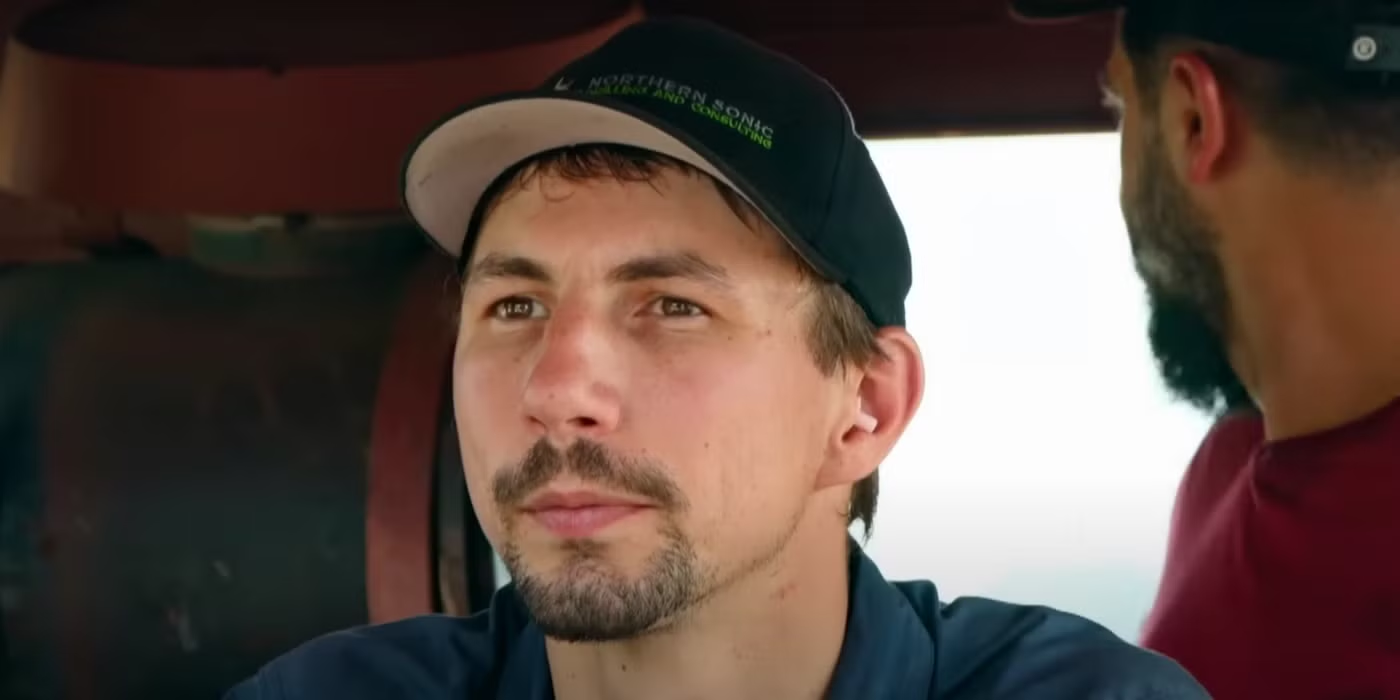
Season 16 of Gold Rush delivered one of its most consequential hours this week, as three major operations across the Klondike faced defining moments in a single episode. Leadership decisions, mechanical failure and a bold recruitment call reshaped the trajectory for Parker Schnabel, Rick Ness and Kevin Beets — with winter edging closer and production targets tightening.
Parker Schnabel Cuts a Veteran to Protect Record Pace
At the forefront remains Parker Schnabel, whose operation has dominated the leaderboard throughout the season. Entering the back half of the year with more than 5,800 ounces recovered — worth approximately $18.7 million — Schnabel is not merely pursuing a solid season. He is targeting a historic total.
But episode 12 revealed signs of strain.
A noticeable dip in weekly output prompted scrutiny within his camp. The cause, according to mine manager Nona Loveless, was not ground conditions or failing equipment, but performance issues linked to a veteran excavator operator with 15 years’ experience.
Tensions had reportedly built over several weeks, with concerns about adherence to instructions and integration within the broader workflow. In a face-to-face meeting, Loveless confronted the operator about underperformance affecting downstream efficiency.
The exchange ended decisively. The operator was dismissed.
“It’s never easy trying to let somebody go,” Schnabel reflected. “But everybody needs to be a team player.”
For an operation built on synchronised movement between excavators, haul trucks and wash plants, even minor inefficiencies can ripple across daily totals. The decision underscores Schnabel’s management philosophy: discipline and cohesion take precedence over tenure.
The immediate question is whether the move came quickly enough. Schnabel still requires roughly 2,650 additional ounces to meet his ambitious seasonal target — more than $9 million in gold at current prices.

Rick Ness Faces Critical Mechanical Failure
While Schnabel addressed internal performance, Rick Ness confronted a more abrupt crisis at Vegas Valley.
Having recently cleared longstanding financial obligations, Ness appeared poised for a steadier stretch. That stability was interrupted when a grinding noise from the wash plant led to the discovery of a severely damaged main bearing within the trommel system.
The failure effectively halted processing operations.
In the Yukon’s compressed mining window, downtime carries heavy consequences. Without a functioning trommel, dirt cannot be processed and revenue stops immediately. Replacement parts must be sourced from regional suppliers, with logistical delays potentially costing days or weeks.
Ness began urgent calls to equipment dealers in Dawson City and Whitehorse, aware that extended disruption could jeopardise his season. With 440 ounces recovered so far — valued at roughly $1.5 million — his campaign has been less about topping the leaderboard and more about regaining stability after previous setbacks.
Time is now his most pressing adversary.

Kevin Beets Takes a Calculated Risk
At Sphinx Cut, Kevin Beets confronted a different challenge: insufficient manpower.
Rather than scale back operations in the temporary absence of a key crew member, Beets opted to recruit an untested operator mid-season. Integrating a new hire into an active mining crew carries operational risk, particularly where coordination and trust are essential.
Initial days were uneven, with communication gaps affecting workflow. By midweek, however, the team found rhythm. Dirt throughput increased and production stabilised.
The result was measurable.
At the weigh-in, Sphinx Cut delivered 47 ounces — approximately $164,000 at prevailing prices. The haul pushed Beets’ season total toward 380 ounces, worth around $1.3 million.
While his figures do not rival the output of Schnabel or Tony Beets — who remains firmly in second place with 3,940 ounces valued at $13.8 million — the week represented validation of Kevin Beets’ leadership decisions.
“As long as we keep a good crew going, it gets us closer to that 2,000-ounce goal,” he said.

The Standings Tighten
With winter advancing and ground conditions becoming more demanding, production margins narrow across the Klondike.
-
Parker Schnabel: 5,855.9 ounces (~$18.7 million)
-
Tony Beets: 3,940 ounces (~$13.8 million)
-
Rick Ness: 440 ounces (~$1.5 million)
-
Kevin Beets: ~380 ounces (~$1.3 million)
Schnabel retains a commanding lead, yet high expectations magnify every slowdown. Tony Beets remains within striking distance should momentum shift. For Ness and Kevin Beets, the season is measured less by headline totals and more by resilience and sustainable growth.
Adaptation as the Defining Theme
Episode 12, titled On Shaky Ground, emphasised a recurring reality of gold mining: adaptation determines survival.
Schnabel chose decisive discipline. Ness confronts logistical urgency. Kevin Beets demonstrated willingness to act under uncertainty.
Across the frozen terrain of the Klondike, there is limited room for hesitation. As the mining window narrows, every operational choice carries amplified consequences.
Whether Schnabel can maintain record pace, whether Ness can restore his plant before losses mount, and whether Kevin Beets can sustain his momentum will shape the remainder of season 16.
In the Klondike, outcomes hinge not only on the richness of the ground, but on the speed and clarity of decisions made above it.