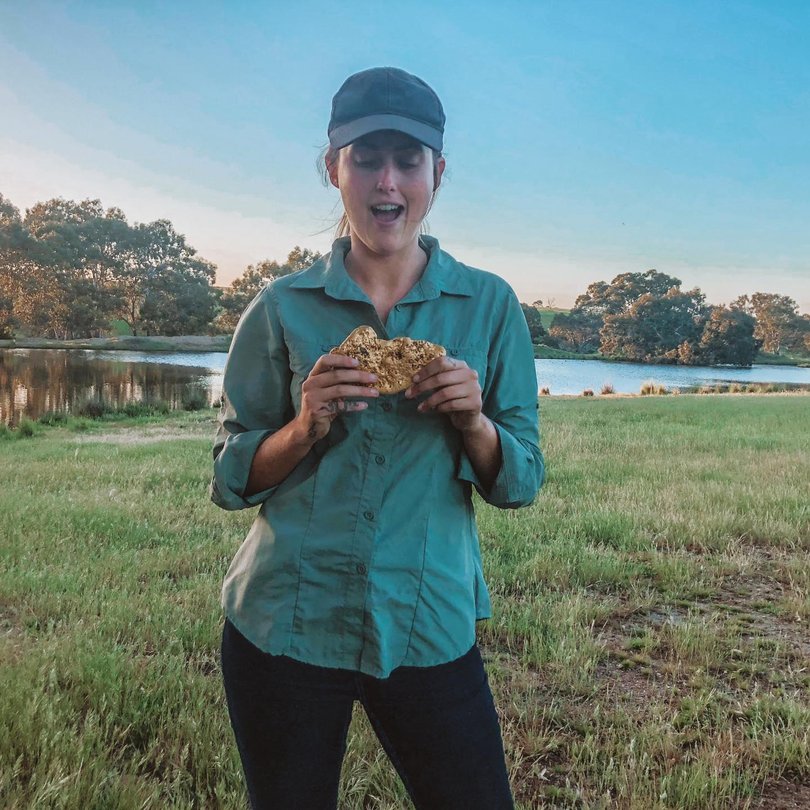
In the vast and rugged landscapes of Western Australia, where the pursuit of gold has long been a way of life, a seasoned prospector named Tyler Mahoney recently found herself utterly astounded by a discovery that stands out even in her extensive career of unearthing precious metals. Mahoney, a prominent figure in the gold mining world and a star of the popular reality television series Gold Rush: Parker’s Trail as well as Aussie Gold Hunters, came across what is being hailed as one of the rarest gold nuggets ever documented—a pristine hopper crystal formation that has sent ripples of excitement through the global prospecting community and beyond.
The story began not with Mahoney swinging a pickaxe in the outback, but through the modern lens of social media, where she first shared her jaw-dropping encounter with the world. Posting from her base near Kalgoorlie, a historic gold rush town in Western Australia, Mahoney revealed images and videos of the nugget, dubbing it the “INCA nugget” due to its striking, almost architectural pyramid-like structure reminiscent of ancient Inca designs. Weighing in at a modest 22 grams, this nugget isn’t remarkable for its size but for its extraordinary crystalline perfection, a natural phenomenon that occurs under highly specific geological conditions and is seldom preserved in such an immaculate state.
The nugget’s origins trace back to the gold-rich fields of Clermont in Queensland, on Australia’s eastern coast, where it was initially unearthed by a local prospector named Alan. This experienced detectorist, armed with metal-detecting equipment, stumbled upon the specimen while scanning the terrain, immediately recognizing its unusual geometric features that set it apart from the typical rounded, water-worn nuggets commonly found in riverbeds or alluvial deposits. Hopper crystals, as experts explain, form when gold precipitates rapidly from super-saturated solutions in hydrothermal veins, causing the crystal edges to grow faster than the faces. This results in a stepped, hollowed-out pyramidal shape, often compared to the growth patterns seen in salt crystals or bismuth. However, in nature, these delicate structures are incredibly fragile and rarely survive the erosive forces of time, water, and sediment movement without being smoothed or fragmented.
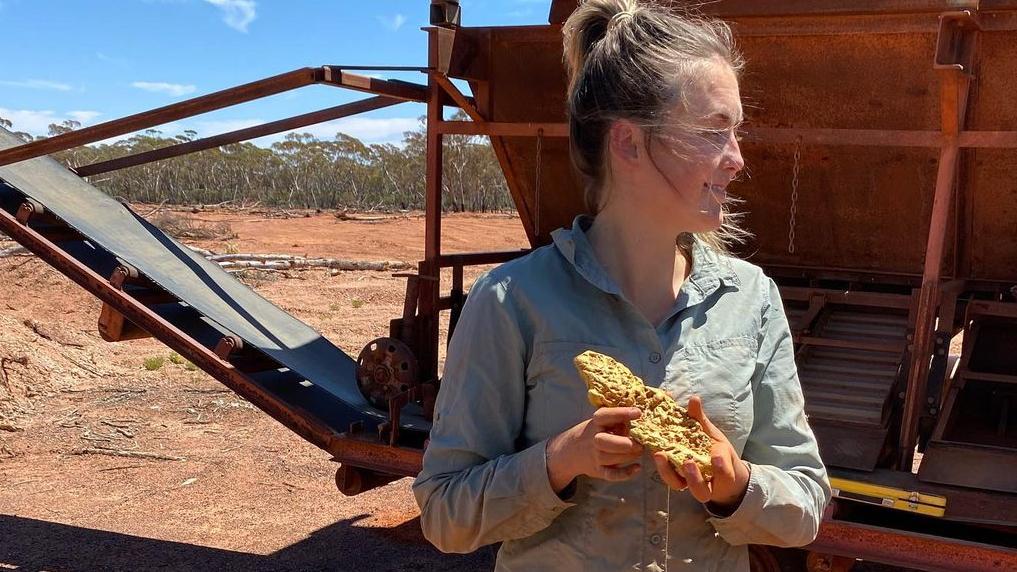
For Mahoney, who grew up in a family deeply entrenched in the mining industry—her father and grandfather were both prospectors in the Kalgoorlie region—the sight of this nugget was nothing short of transformative. Having dedicated her life to the thrill of the hunt, scouring remote bushlands with advanced detectors and sifting through pay dirt, she has handled countless nuggets over the years. Yet, as she recounted in her viral social media post, the INCA nugget left her speechless. “I’m holding one of the world’s rarest gold nuggets. I will never ever hold anything like this again, and I’m a gold digger; I do this for a living,” she exclaimed, her voice filled with genuine awe. She described the moment she first saw a photograph of it: “When I saw a photo of this, my jaw dropped to the floor. This is insane—it is one of the rarest types of gold nuggets in the world.” Her enthusiasm was palpable, drawing in thousands of likes, shares, and comments from fellow miners, collectors, and fans of her TV exploits.
The path to owning this rarity was far from straightforward, adding a layer of drama to the tale that mirrors the high-stakes adventures depicted on Gold Rush. Upon learning of the find, Mahoney entered into a heated bidding war with another eager prospector, both vying to claim this geological marvel. The competition was intense, with offers escalating as each party recognized the nugget’s potential value not just in monetary terms, but as a one-of-a-kind collector’s item. In the end, Mahoney emerged victorious, securing the nugget through a combination of determination and perhaps a nod to her celebrity status in the mining world. Reflecting on the acquisition, she admitted, “If I had found something like this, I would have never got over it. This is a once-in-a-lifetime find—this is a collector’s edition nugget.” Her words underscore the emotional high that comes with such discoveries, a sentiment shared by many in the prospecting fraternity who spend years in the field chasing elusive glimmers of yellow metal.
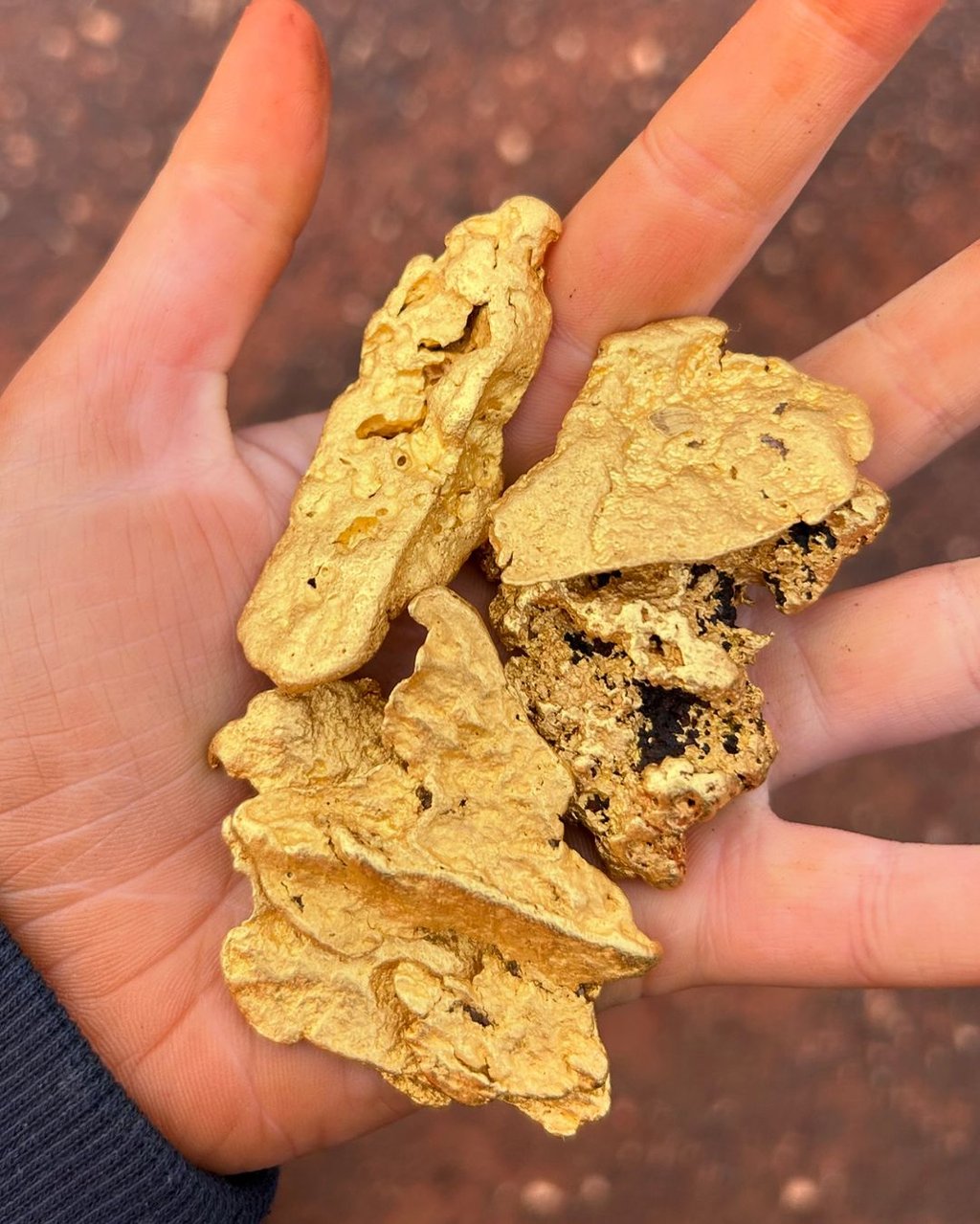
What elevates the INCA nugget to legendary status is its defiance of natural wear and tear. Most gold nuggets, formed deep underground and then transported by rivers or glacial activity, end up with rounded edges and irregular shapes due to prolonged exposure to abrasive elements. In contrast, this specimen boasts sharp, geometric facets—almost perfect straight lines and rectangular forms that give it an otherworldly appearance. As Mahoney elaborated in her post, “This just does not occur in nature like this. Those perfect straight lines, almost perfect rectangles—shapes like that don’t naturally occur, and that’s what makes it so rare.” Geologists and mineralogists agree, noting that hopper crystals require precise conditions: rapid cooling in a stable environment free from disturbances, allowing the crystal lattice to build in a stepped manner without interruption. Such formations are more commonly associated with lab-grown crystals or other minerals like halite, making a natural gold hopper of this quality a true anomaly, perhaps one in a million among known nuggets.
True to her entrepreneurial spirit—Mahoney also runs a prospecting club and collaborates on gold auctions— she didn’t hoard the treasure for long. Recognizing its appeal to serious collectors, museums, and investors, she decided to put the INCA nugget up for auction. The event, facilitated through channels familiar to the mining community, attracted bids from around the globe, highlighting the nugget’s international allure. After a flurry of interest, it ultimately sold for an impressive $15,500, a price that reflects not only its rarity but also the growing market for natural gold specimens as investments and display pieces. This sum far exceeds the intrinsic melt value of the gold (around $1,800 at current market rates), underscoring the premium placed on its aesthetic and historical significance.

Mahoney’s experience with the INCA nugget has sparked renewed fervor in the gold prospecting scene, reminding enthusiasts that Australia’s vast outback still harbors secrets waiting to be revealed. From the historic goldfields of Victoria and New South Wales to the remote deserts of Western Australia and Queensland, modern detectors and satellite mapping are enabling discoveries that blend old-school grit with cutting-edge technology. For Mahoney, this find serves as a pinnacle moment in a career filled with ups and downs, from battling harsh weather to navigating the realities of sustainable mining. It also shines a light on the broader industry, where women like her are breaking barriers in a traditionally male-dominated field. As she continues her adventures on screen and in the field, the INCA nugget stands as a testament to the enduring magic of gold hunting—proving that in an era of digital distractions, the earth’s ancient treasures can still captivate and inspire wonder across the globe.