Freemasons, Forgotten Logs, and the Hunt for Treasure: The Oak Island Team Zeroes in on the Money Pit


The search for the fabled Oak Island treasure continues with renewed intensity as Rick and Marty Lagina, along with their dedicated team, combine cutting-edge science and historic lore to uncover what may be the final clues to the island’s enduring mystery.
Their efforts stretch back to 2006, but the deeper roots of their exploration date to treasure hunters of the past—most notably Gilbert Hedden, who dug the “Hedden Shaft” in the 1930s believing he had located the legendary Money Pit. His work, alongside that of Professor Irwin Hamilton—a fellow Freemason—has become a cornerstone of the team’s modern investigation.
Freemasons, Templars, and Hidden Clues
Much of the intrigue surrounding Oak Island stems from its connections to secret societies. The Freemasons, whose origins trace back to 17th-century Europe, are believed to be spiritual descendants of the Knights Templar. Hedden, a man of conviction, may have believed the Templar treasure was hidden beneath the island’s surface. Though financial troubles forced him to abandon his search in 1938, he passed the torch to Hamilton, continuing a Masonic legacy of investigation.

Researchers have even drawn connections between Irwin Hamilton and President Franklin D. Roosevelt, another Freemason and early Oak Island enthusiast.
Rediscovering the Hedden Shaft and Ancient Tools
Recently, the team redoubled efforts near the rediscovered Hedden Shaft. In 2020, they unearthed a forged rose-head spike, covered in cement—eerily similar to artifacts found in 1897 that first inspired Hedden’s dig. Believed to predate the 1700s, the spike suggests human activity in the pit centuries ago. Water tests in the area show the presence of precious metals, strengthening belief that the original Money Pit lies close to grid point D11.
Swamp Secrets: Logs, Stones, and the “Eye”
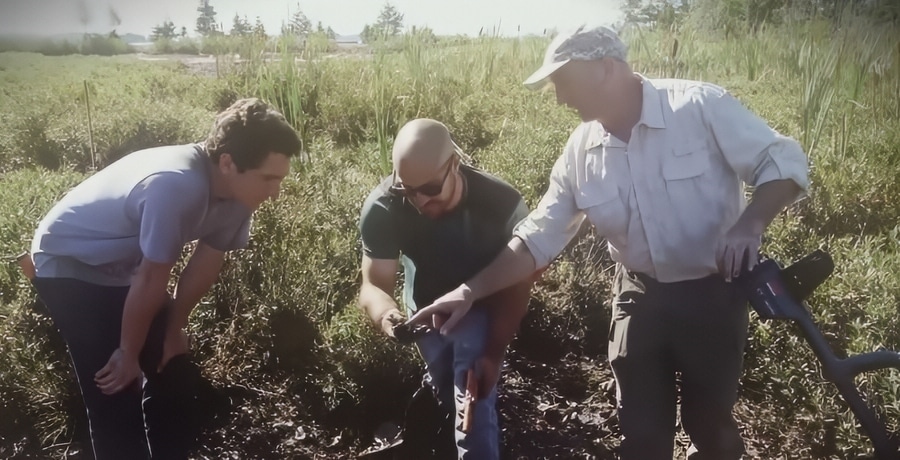
Parallel to the Money Pit search, activity around the mysterious swamp region has intensified. Rick, Alex Lagina, metal detection expert Gary Drayton, and heavy equipment operator Billy Gerhardt have discovered what appears to be a carefully constructed log-and-stone platform buried beneath the earth.
Dr. Ian Spooner believes this construction is not natural. Logs over 14 feet long lie beneath heavy root systems and stacked cobblestones—indicative of a man-made platform. Organic sampling is underway to date the site. If confirmed to be from the late 1600s, this could tie directly to 17th-century treasure operations, possibly by English treasure hunter Sir William Phips and his Masonic associate, Capt. Andrew Belcher.

A nearby circular rock formation, dubbed the “Eye of the Swamp” due to its similarity to the Masonic all-seeing eye, was dated by Dr. Spooner to between 1680 and 1700—adding weight to the theory of early organized treasure efforts on the island.
Lot 5: Buttons, Bullets, and Bobby Dazzlers
On the western side of the island, Lot 5 has yielded a treasure trove of its own. Gary Drayton and Jack Begley sifted through over 10 tons of soil and uncovered artifacts including buttons, lead balls, and a hammered silver piece.
While the silver item proved modern due to high aluminum content, other finds—like a starburst button and a scalloped lead token—appear far older, possibly predating the 18th century. These artifacts may directly connect to the creators of a mysterious stone foundation nearby.
Archaeologist Helen Sheldon believes the silver hints at treasure-related activity. Archometallurgist Emma Culligan is analyzing the finds with X-ray fluorescence, hoping to identify a link between the recovered items and known historical figures or events.
The Road Ahead
As the team prepares to date large swamp logs and explore more of Lot 5, spirits remain high. Every artifact fuels the drive for answers. Rick Lagina remains focused, emphasizing that each discovery—be it a button, a log, or a stone—may be the key to unlocking a centuries-old secret.
With multiple man-made features now revealed, and evidence of industrial activity dating back to the 1600s, the mystery of Oak Island may be closer to unraveling than ever before.
Have they finally uncovered the path to the real Money Pit? The world watches, one “top pocket find” at a time.