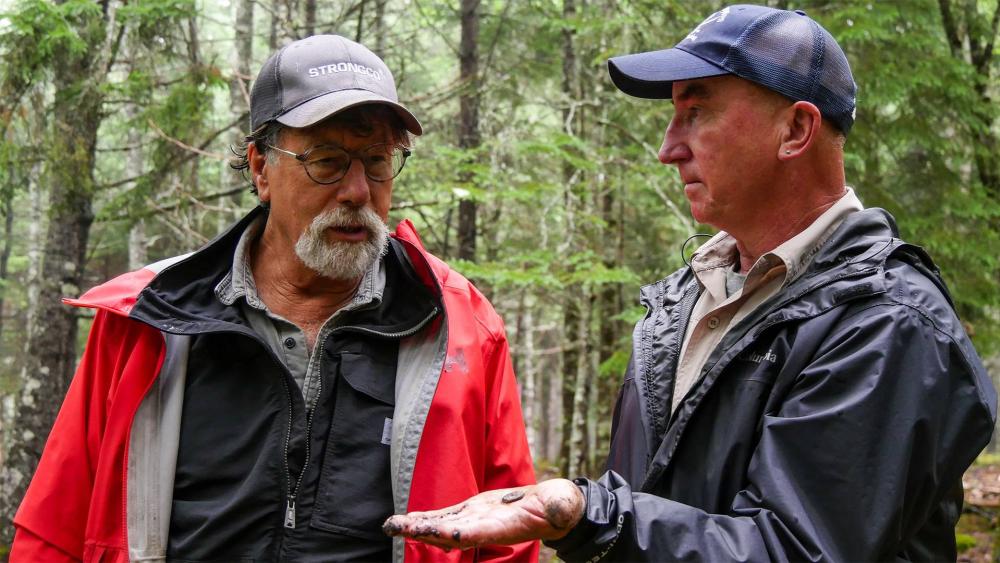
The relentless pursuit of Oak Island’s legendary treasure shows no signs of slowing, as brothers Rick and Marty Lagina and their dedicated team report groundbreaking discoveries that could finally crack the 230-year-old mystery. From ancient ceramics and coins on Lot 5 to sonar revelations in Aladdin’s Cave beneath the Money Pit, the latest season of The Curse of Oak Island on History Channel has delivered astonishing evidence of early European—and possibly even Roman or Templar—activity on the island. But with government interventions over indigenous artifacts, the quest faces new hurdles. Could the end be near, or is Oak Island’s curse striking again?
The team’s focus has intensified on Lot 5, once thought to be a simple homestead but now suspected as a key deposition site akin to the infamous Money Pit. Excavations in a stone-outlined circular depression—marked decades ago by former owner Robert Young—have yielded red pottery shards with purple and dark glazes, dated by archaeologist Laird Niven to the 1600s. “I’ve never encountered such an old ceramic artifact on the island before,” Niven admitted. Thicker earthenware pieces followed, suggesting pre-Money Pit habitation and raising questions about who was digging here centuries ago.

Metal detecting sweeps by expert Gary Drayton have turned Lot 5 into a veritable coin bonanza. Four ancient coins were unearthed in quick succession, each hand-forged with patinas hinting at great age. XRF scans and CT imaging at the interpretive center revealed compositions of copper, silver, silicon, lead, tin, and brass. One matches a previously found Roman-style coin, potentially linked to Knights Templar depositors; another resembles a 13th-century French denier, echoing a lead cross from southern France. A fourth may also be Roman, fueling theories of French explorers or Templars using the island as a hideout.
Deeper probes uncovered iron artifacts, including a metal strap possibly from a treasure chest, a rose-head fastener resembling a mining chisel, and a bow-shaped decorative piece dated pre-17th century. Blacksmith Carmen Legge confirmed French origins for many items, challenging the notion of a single depositor group. “This style was commonly used by the French,” Legge noted, tying into Zena Halpern’s research on French Templar maps.
In the Money Pit area, drilling in boreholes like D5-N265 and DN12 hit wood at 105-112 feet, indicating tunnels or structures. Gray soil and fragments suggest an original depositor’s tunnel aligning with the Garden Shaft, potentially leading to the “Baby Blob” zone or an offset chamber. Sonar imaging in Aladdin’s Cave at 150 feet revealed straight lines, square walls, and slopes—clear signs of man-made activity. Camera feeds showed jagged edges and possible passageways, with faint echoes hinting at entrances. “There’s something man-made inside Aladdin’s Cave,” Marty Lagina declared.

Near Lot 5’s shoreline, iron spikes and a handle from 1600s-1700s scissors—matching Dan Blankenship’s earlier find—point to shipbuilding or tunnel construction. A rectangular foundation, dated to the 1700s but built around an older 1600s circular feature, contained creamware pottery from 1762 and porcelain teacup fragments, suggesting military operations or luxury trade.
Yet, triumphs are tempered by setbacks. Discoveries of Mi’kmaq pottery fragments in Season 9 led to government shutdowns, dismissing archaeologists and imposing stricter rules. Recent bone fragments and a potential Viking artifact prompted mining permit demands, halting invasive digs. The team has pivoted to non-invasive tech like seismic scans, which revealed a 60-foot-deep linear anomaly near the Cave-In Pit, akin to the Smith’s Cove flood tunnel.
As Season 12 unfolds, with episodes like “And the Hits Keep Coming” promising swamp connections and Italian coin analysis linking to the Roman Empire, fans speculate: Are the Laginas nearing the treasure? Rick remains cautious: “Progress on Oak Island always comes in gradual steps.” But with palladium traces in wood samples hinting at precious metals nearby, the island’s secrets may soon surface.

Sidebar: Key Artifacts and Their Implications
- 1600s Red Pottery (Lot 5): Purple-glazed shards suggest early European trade, predating Money Pit.
- Ancient Coins: French denier (13th century), Roman-style with female engraving—possible Templar links.
- Iron Chisel and Strap: Pre-17th century French tools, indicating tunneling or chest remnants.
- Wood Fragments (Money Pit): From 105-112 ft, matching tunnel materials; no gold but palladium present.
- Scissors Handle: 1600s-1700s, tied to construction phases.
- Creamware and Porcelain: 1760s luxury items in rectangular foundation, hinting at military elite.
Government Roadblocks: Indigenous Finds Force Halt on Oak Island Digs
The Curse of Oak Island isn’t just supernatural—it’s bureaucratic. Canadian officials have repeatedly intervened, citing indigenous artifacts like Mi’kmaq pottery from Season 9, leading to excavation shutdowns and archaeologist dismissals. “We would no longer be allowed to use standard archaeological techniques,” Marty Lagina lamented.
Recent digs near the Garden Shaft uncovered potential chambers and Viking items, but hiring Dumas Contracting triggered mining permit requirements. Critics argue safety concerns, given six historical deaths, but fans decry delays. The team now relies on seismic and GPR tech, uncovering anomalies like a flood tunnel echo, but invasive work remains stalled. Will regulations bury the treasure hunt for good?