Oak Island S13E3: Shaft Discovery Reveals Hidden Tunnel Network — Ending Twist Explained


Oak Island, Nova Scotia – In a pulse-pounding installment of The Curse of Oak Island, Season 13 Episode 3—”Medieval Intentions”—the Lagina brothers and their tenacious team unearthed artifacts that could rewrite the island’s enigmatic history, blending Roman relics with potential Templar ties in a hunt that’s spanned over two centuries and claimed six lives. With gold detectors beeping and drills plunging deeper than ever, the episode delivered a torrent of clues hinting at ancient European visitors, secret pathways, and a treasure that refuses to stay buried.
The action ignited in the island’s notorious swamp, where Rick Lagina, Steve Guptill, Billy Gerhardt, and the crew targeted an unexplored western section armed with fresh permits. After draining the bog, they struck paydirt almost immediately: axe-cut wooden stakes aligned in a row, echoing similar finds from last season’s vault-like feature dated to the 1600s. These posts, potentially marking ancient pathways or borders for clandestine operations, fueled speculation about early European activity. “Are they defining secret work yet to be revealed?” pondered the team, as carbon dating efforts kicked off to anchor them in Oak Island’s multi-generational timeline.
Shifting to the lab, the spotlight fell on a stunning Roman coin recovered from Lot 5, joining five others from the prior season. Analyzed by experts including Emma Culligan via CT scan and alloy breakdown, the coin—featuring a bust and inscription from Emperor Claudius II’s reign around 270 AD—revealed a copper base with silver traces, matching metals from the Money Pit’s waters. Coin specialist Sandy Campbell weighed in: Roman currency circulated for centuries, possibly reaching the North Atlantic via traders, Templar explorers, or even the Money Pit’s builders as far as the 1500s. “This isn’t just pocket change,” Rick Lagina declared, emphasizing its role as evidence of historical visitors rather than the treasure itself.
Lot 5 digs yielded more tantalizing pieces: Fiona Steele and Tanit Rudnicki uncovered a clay pipe stem with a mid-1700s borehole, fragments of an ornate bowl from the 1600s-1800s, and a exquisite blue glass bead. XRF analysis pegged the bead as Venetian, traded by Europeans in the late 1600s—potentially by Knights of Malta or Templars, given links to Acadia’s founder Isaac de Razilly, a Knight of Malta, just 15 miles away at Fort Point on the LaHave River. These finds scream overlapping occupations on an island with no recorded settlements, amplifying theories of conspiratorial groups predating the Money Pit’s 1795 discovery.
The Money Pit assault ramped up with borehole J-58, aimed at the elusive “solution channel”—a natural void rumored to harbor sunken riches. Drills dropped rods up to 30 feet without resistance, shattering prior maps by reaching 233 feet—deeper than the assumed 220-foot bottom. Cores pulled powdery bedrock and minor debris, but the vast cavity’s scale left the team buzzing: Could collapsed chests or artifacts have settled here after centuries of erosion? “We’re on the cusp,” Rick urged, stressing perseverance amid the edge-of-your-seat tension.
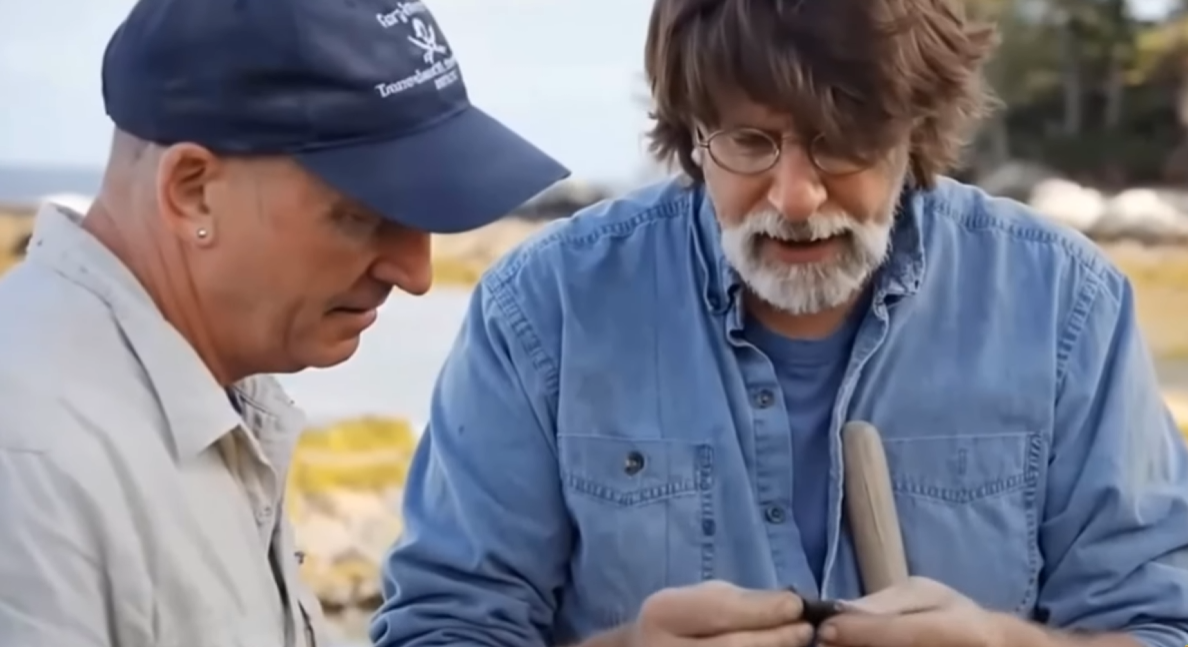
The episode’s twist came on Lot 4, where Gary Drayton and Charles Barkhouse sifted excavated dirt from Lot 5’s round feature, unearthing a lead strip with beveled edges and a hole—possibly an arm from a medieval lead cross akin to the 2017 Smith’s Cove find. Consistent with Templar symbols from France, Italy, and Iceland, it could solidify a 14th-century connection, perhaps matching a prior barter token. Additional artifacts like buttons, pottery shards, iron items, glass beads, and ox shoes rounded out the haul, blending excitement with skepticism as the team grappled with Mi’kmaq, Roman, and Templar threads.
As discoveries stack—Roman coins, Venetian beads, medieval lead fragments, and mysterious stakes—Oak Island’s puzzle inches toward seismic revelations. Rick summed it up: “We’re dealing in facts now.” Yet, with no golden chest in sight, the real treasure remains the unfolding global epic of conspiracy and legend. Fans are abuzz: Could these clues finally crack the code?
The Curse of Oak Island airs Tuesdays at 9 p.m. ET on History Channel, with episodes streaming on History.com. As winter grips Nova Scotia, the Laginas’ quest shows no signs of cooling.