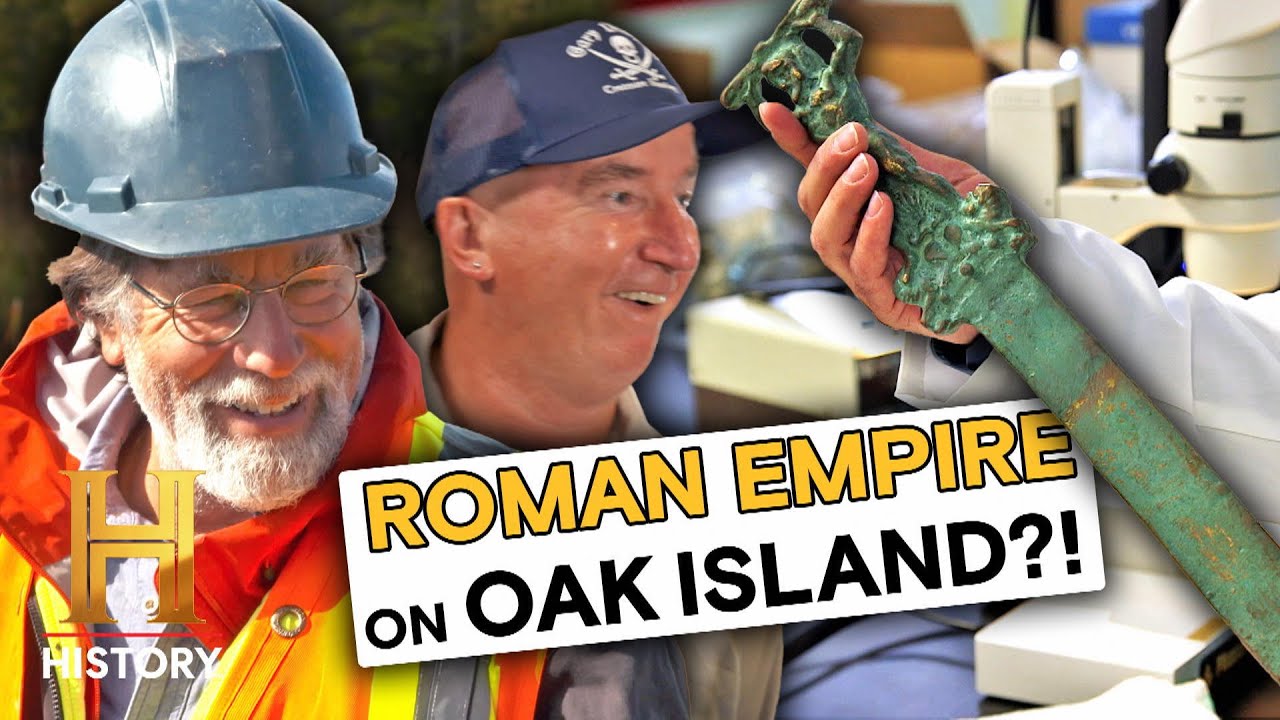
As a new week begins on Oak Island, the Lagina brothers—Rick and Marty—along with Marty’s son, Alex, Craig Tester, and Dave Blankenship, embark on another journey. Their latest quest takes them 50 miles northeast to St. Mary’s University in Halifax, where they are eager to determine the authenticity of an artifact resembling an ancient Roman sword.
The Mysterious Roman Sword
The team meets with Professor Myles McCallum, an expert in Roman archaeology, hoping to confirm whether the sword reportedly found in waters off Oak Island is of genuine Roman origin. As they examine the artifact, initial reactions range from excitement to skepticism.
Professor McCallum notes that while the sword bears the depiction of Hercules, a significant Roman religious figure, its construction technique raises doubts. The presence of a mold line suggests it was cast using a bivalve mold rather than the single lost-wax casting method typical of authentic Roman swords. This leads to speculation that the sword may be a more recent reproduction rather than an ancient relic.
Despite these doubts, the artifact still holds potential significance. Even if not an original Roman weapon, it could be an antiquity brought to Oak Island centuries later. The possibility of a historical connection remains intriguing.
The Discovery of a Roman Coin
Back on Oak Island, another exciting find emerges a cut copper coin discovered on Lot 5 by Rick Lagina and metal-detecting expert Gary Drayton. The team welcomes numismatist Sandy Campbell to examine the artifact, and initial X-ray fluorescence (XRF) analysis indicates a composition of copper, lead, tin, arsenic, and silver characteristics that suggest a pre-16th-century origin.
After further inspection, Campbell delivers a stunning hypothesis: the coin may be Roman, potentially dating between 300 BC and 600 AD. The implications are staggering could the Romans, or those who possessed their artifacts, have traveled to Oak Island?
Templar Connections and Previous Findings
The discovery of a Roman-era coin recalls a past investigation by the Lagina team in Portugal, where they found a stone road strikingly similar to the one discovered in the swamp on Oak Island. Given that Portugal was once part of the Roman Empire, the connection raises questions about whether Templar-affiliated explorers, who might have possessed Roman artifacts, could have played a role in Oak Island’s history.
The discovery of this coin aligns with other unusual finds:
- A medieval lead cross found in Smith’s Cove in 2017
- High traces of gold detected in the Money Pit area
- A possible dam feature in the swamp
If the Knights Templar did bring ancient Roman artifacts to Oak Island, it could provide a link between European explorers and the island’s enduring mystery.

Unearthing More Clues in the Swamp
Rick, Gary, and Billy Gerhardt return to the swamp to further investigate a suspected manmade stone ramp. As they dig, they quickly uncover another artifact—a small, corroded horseshoe.
Blacksmithing expert Carmen Legge later examines the find and determines that the horseshoe is not a draft horse shoe, but rather one meant for a riding or cavalry horse. Most notably, he estimates it dates back to the 1400s, making it the oldest horseshoe discovered on the island thus far.
The Growing Mystery
The discoveries of a possible Roman coin, an ancient horseshoe, and the stone ramp deepen the mystery surrounding Oak Island. If the coin truly originates from the Roman era, and if European explorers transported Roman relics to the island, it could reshape historical perspectives on transatlantic travel before Columbus.
As the team continues their investigations, Lot 5 has now firmly placed itself on Oak Island’s treasure map. With more rigorous scientific analysis ahead, the question remains: who brought these artifacts to the island, and what secrets does Oak Island still hold?
