A fresh wave of excitement and speculation has taken hold of Oak Island’s legendary Money Pit after a series of jaw-dropping discoveries by the team led by brothers Rick and Marty Lagina. What began as a routine exploration on Lot 8 has transformed into an archaeological and historical whirlwind—linking the mysterious island not only to ancient artifacts, but possibly even to the Knights Templar.
WHO:
The treasure-hunting team includes the Lagina brothers, Rick and Marty, backed by the History Channel and the A&E Network, along with expert contributors like Gary Drayton, metal detection specialist, and Jack Begley, longtime researcher and field producer. Their support crew also includes historians like Scott Clarke, a Freemason who has provided insight into religious and ceremonial artifacts.
WHAT:
Recent discoveries include:
-
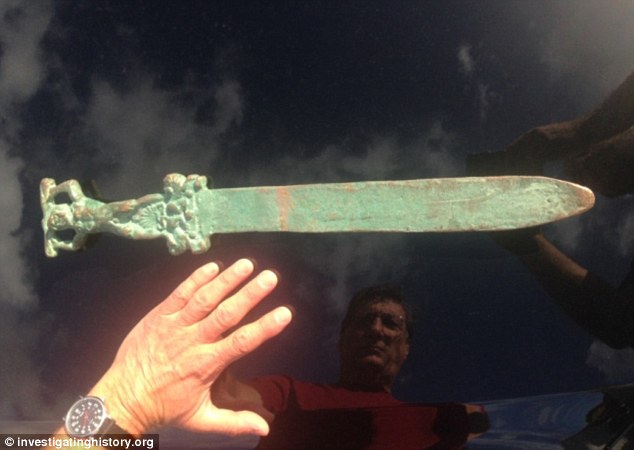
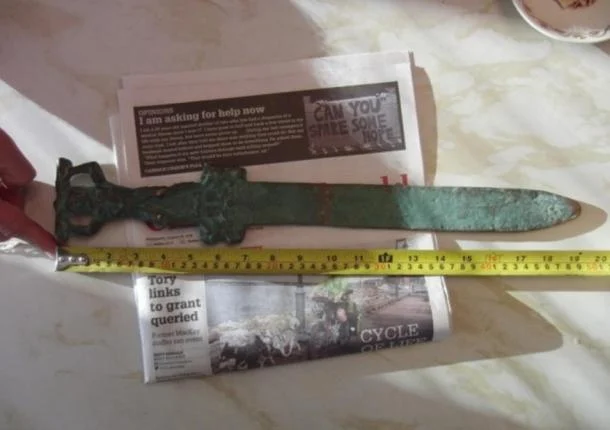
A ceremonial Roman sword (initially believed to be ancient, later revealed to be a modern replica).
-
A 16th-century bunk hook, possibly used to haul cargo.
-
Paving stones resembling medieval pathways leading toward the Money Pit.
-
A chain with oval links, thought to secure treasure chests.
-
A decorative bluish-green copper artifact, speculated to be a gorget or ceremonial piece.
-
Coconut fibers—curious and exotic—unearthed deep within the pit.
-
A floral keyhole plate, possibly connected to the lost treasure of Captain James Anderson.
-
A silver floral ring, believed to date to the early 1700s, potentially of Spanish origin.
-
A semi-precious garnet gemstone found on Lot 8, linked by some to Templar rituals.
WHEN & WHERE:
The discoveries were made throughout early 2025, with the March 28th revelations being the most publicized. All artifacts and features were found on Oak Island, primarily in the areas known as Lot 8 and the infamous Money Pit—a site of excavation dating back to 1795.

WHY:
These explorations are part of the Lagina brothers’ long-standing mission to solve the Oak Island mystery. Motivated by tales of buried treasure, secret societies, and ancient visitors, the team seeks to uncover both material riches and historical truth. The artifacts may support bold theories connecting Oak Island to:
-
The Knights Templar
-
Ancient Roman expeditions
-
Spanish treasure fleets
-
Indigenous peoples
-
European explorers or fur traders
HOW:
Through careful excavation, metal detection, expert analysis, and historical consultation, the team is piecing together a narrative long buried under stone and soil. Tools like ground-penetrating radar, historical maps, and artifact dating are helping to verify the findings. Despite some setbacks—like the Roman sword turning out to be a replica—the team presses on, energized by each new clue.

A CLOSER LOOK: FAKE OR FACT?
One dramatic turn came when the ceremonial Roman sword, thought to be proof of ancient trans-Atlantic contact, was later identified as a modern forgery. “It could even be a fake from the 1800s,” Marty Lagina said in frustration. “Still, it’s a reminder that every discovery must be tested.”
LEGEND & LEGACY:
The Oak Island treasure legend began over two centuries ago, when three boys found a mysterious depression in the ground. Since then, the island has consumed millions of dollars, claimed lives, and fueled endless speculation. No confirmed treasure has ever been recovered, yet the dream persists.
THE ROAD AHEAD:
With each layer of earth unearthed, Oak Island offers new questions instead of answers. Still, the finds—whether genuine or misinterpreted—have deepened public intrigue and provided historical breadcrumbs for the next generation of explorers.
“This place,” says Rick Lagina, “is telling us a story. And we’re just now beginning to listen.”
Stay tuned for more updates as the mystery unfolds.