The Curse of Oak Island Season 13 Episode 13: Silver was Everywhere Beneath the Money Pit


The latest instalment of The Curse of Oak Island offers one of the season’s most tightly constructed and consequential chapters to date. Episode 13 does not hinge on a single discovery, but on convergence — a rare moment when archaeology, geology, metallurgy and historical context begin to reinforce one another. For viewers, it marks a shift in tone: less speculation, more structure; fewer isolated finds, more signs of deliberate design.
At the centre of the episode is the imposing boulder on Lot 8, now widely regarded by the team as anything but natural. Sitting atop a series of evenly spaced stones, the feature is undercut by a trench filled with rubble — a configuration multiple specialists agree points to human construction. What elevates the find further is evidence of voids beneath the rock. Camera footage reveals open spaces, a possible iron spike, and a reflective object that has sparked debate among the team. Crucially, the discussion moves away from whether someone once dug here in search of something, and towards the more compelling idea that the cavity may have been intentionally sealed. A plug implies planning, concealment and purpose.
This line of thinking brings familiar tension to the surface. Marty Lagina voices impatience, keen to push forward, while archaeologists urge restraint to preserve context. The compromise — careful hand excavation before any attempt to move the boulder — reflects a more disciplined approach than in earlier seasons. That caution is rewarded when a small but potentially transformative find emerges: a fragment of red-dyed wool fabric discovered beneath one of the stones.

Laboratory analysis confirms the textile is wool, coloured using a natural red dye rather than modern chemicals. Its depth and position suggest it predates later search activity. While modest in appearance, the fragment carries significant weight. Red-dyed wool was a hallmark of medieval England, particularly in Leeds, a major wool centre as early as the 13th century. The connection gains further credibility when considered alongside a previously recovered English bag seal bearing a sheep symbol, also linked to Leeds. Together, these finds hint at European trade connections on Oak Island far earlier than conventional timelines suggest.
While Lot 8 delivers context, the Money Pit advances the possibility of material recovery. Drilling continues deeper into the solution channel, now viewed as a potential repository for displaced objects after centuries of collapse and flooding. Core samples pulled from depths beyond 200 feet repeatedly show loose material rather than bedrock — a promising sign. Metal detector signals within the cores initially prove elusive, fading when samples are moved, but further analysis suggests the presence of microscopic metallic particles.
The significance becomes clear in the war room. X-ray fluorescence testing reveals unusually high concentrations of elemental silver in multiple boreholes. Importantly, the silver is attached to clay particles, indicating a nearby solid source rather than natural dispersion. Experts stress that silver at these levels does not occur randomly in the island’s geology. The implication is that valuable objects once existed intact before migrating downward through collapse. This finding lends fresh credibility to long-debated historical accounts, including reports of a Portuguese coin recovered in the 19th century.
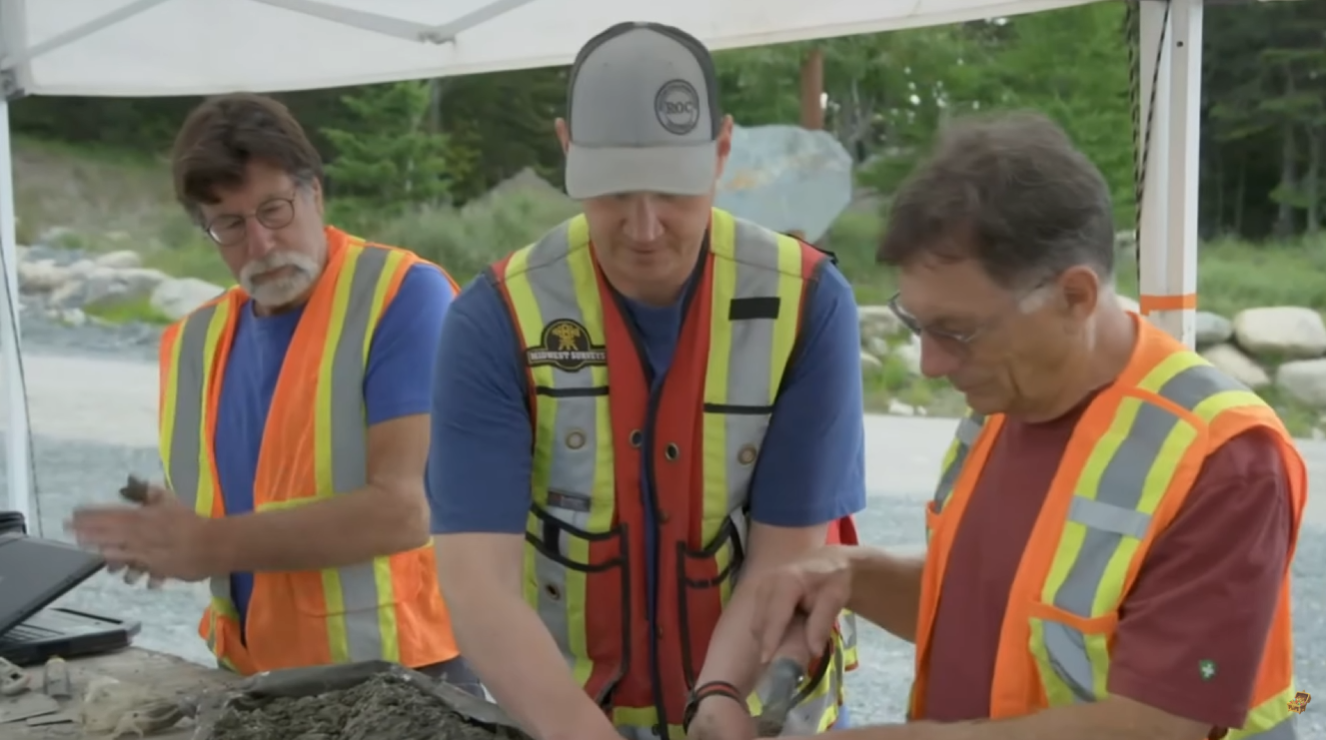
Elsewhere, the swamp investigation continues to gather momentum. Gary Drayton and the team trace a cobblestone pathway running in a straight line across the swamp, reinforced by embedded bricks and cut wood. These features remove lingering doubts about natural formation. The alignment of multiple stone platforms suggests a constructed route — possibly a road or causeway — designed to move heavy materials across difficult terrain.
What stands out is direction. Survey markers indicate the pathway appears to turn intentionally, possibly toward Lot 8. If correct, it strengthens the emerging theory that the island’s features are interconnected components of a broader plan. The boulder, the swamp road and the Money Pit may represent elements of a coordinated system rather than isolated anomalies.
By the end of the episode, a systems-based interpretation of Oak Island has clearly taken hold. The focus shifts from searching individual points to understanding how the island may have functioned as an engineered landscape. This perspective reframes earlier discoveries and raises the possibility of sophisticated planning, long-term concealment strategies and a level of organisation previously underestimated.
Episode 13 also underscores a broader truth about the search: the most revealing evidence is often subtle. A textile fragment can offer more insight than precious metal because it carries cultural and temporal markers that cannot be moved or melted away. In that sense, the episode prioritises understanding over spectacle.
Whether or not tangible riches are eventually recovered, this chapter suggests the team is uncovering something equally significant — a coherent narrative of human intent on Oak Island. As drilling escalates and careful excavation continues, the mystery feels less fragmented than ever before. For a site that has resisted clarity for centuries, that alone marks a notable step forward.