
A recent excavation in the northern region of the swamp has reignited hopes of uncovering hidden treasure as the Lagina brothers, along with their team, unearthed what appears to be key man-made structures dating back centuries.
A Long-Awaited Dig
The search, spearheaded by Rick and Marty Lagina alongside Craig Tester and Tom Nolan, son of the late legendary treasure hunter Fred Nolan, focused on an area that has long been suspected of holding valuable secrets. Nolan’s belief in hidden caches led him to drain the swamp in 1969, revealing remnants of large sailing vessels and 16th-century survey stakes—clues that he theorized pointed to a deliberate effort to conceal treasure.
Now, after years of research and excavation, the Oak Island team has made several new finds that could validate Nolan’s theories.
Sharpened Stakes and Cobblestone Pathways
During their most recent dig, the team uncovered sharpened wooden stakes, remarkably well-preserved despite centuries underground. “It just looks like the day it went into the ground,” noted Tom Nolan, while metal detection expert Gary Drayton marveled at the hand-hewn craftsmanship.
Nearby, another intriguing find emerged: a section of cobblestone pathway. “It’s almost like they’re stacked,” observed Rick Lagina. “We have to follow this. There’s no question about it.”
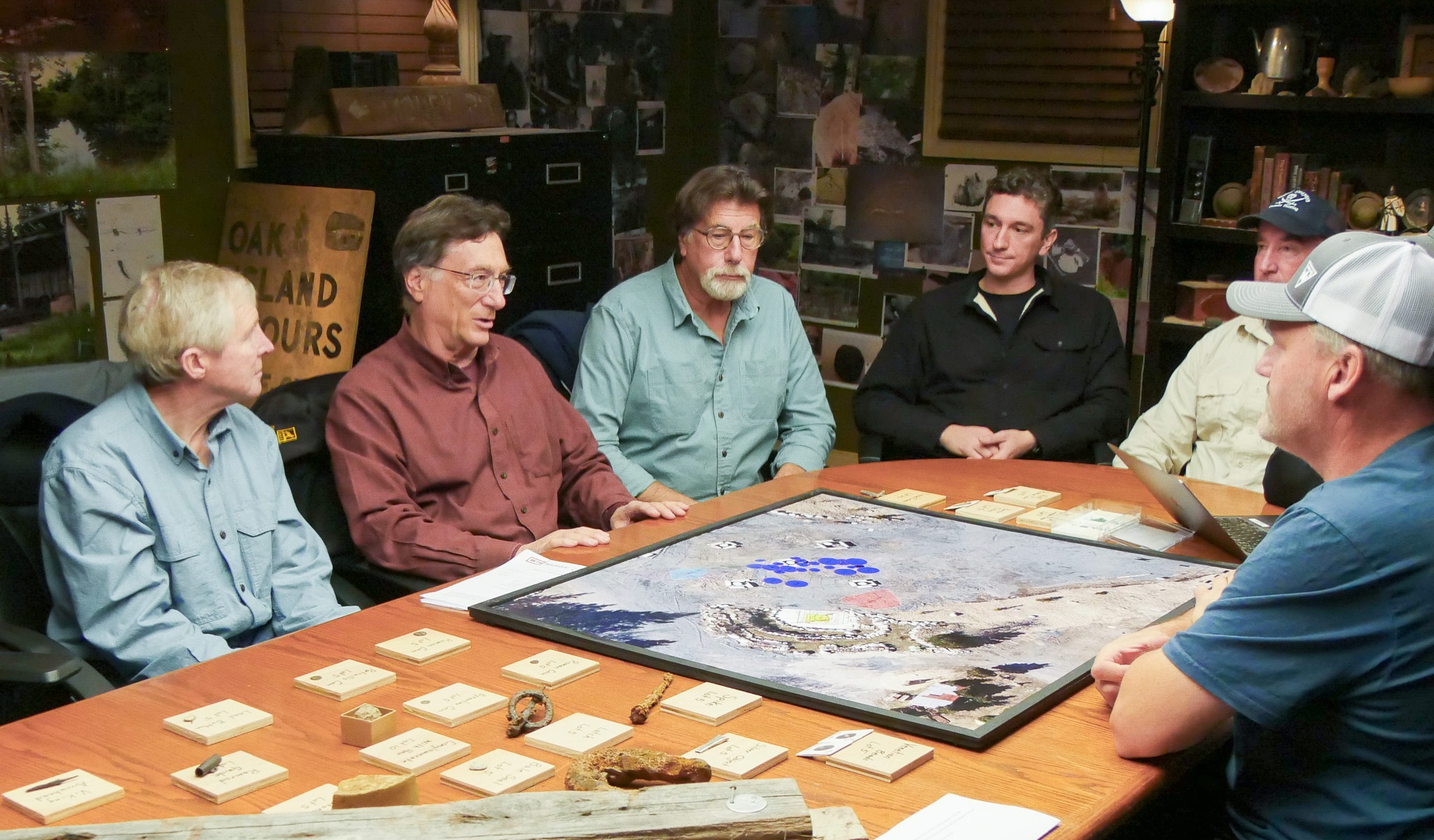
These discoveries led to the involvement of geoscientist Dr. Ian Spooner, who analyzed the formation and concluded that the stones appeared to be intentionally placed. The team hopes this pathway could lead to a vault containing long-lost treasure.
Surveying the Evidence
Surveyor Steve Guptill later compiled the team’s findings into a digital map, revealing a striking connection between the newly discovered features and previous excavations. The data suggests that a series of survey stakes, a cobblestone path, and an underground vault-like structure are all aligned, forming a straight north-south path.
“This is consistent with a surveying use,” Guptill explained. “If these were reference points, they were for a significant construction site.”
A 17th-Century Mystery Unfolds
Further analysis of the artifacts has linked them to a time period between the late 1600s and mid-1700s, well before modern search efforts began.

“These dates are everywhere,” noted Jack Begley. “1600s, 1700s—whatever happened on Lot 5, the swamp, and the Money Pit, it was all part of a much larger operation.”
The new findings also hint at a possible connection to the Duc d’Anville expedition, a French military campaign in the 1740s. Could Oak Island’s mysteries be tied to French naval operations?
What’s Next?
With mounting evidence of extensive, centuries-old construction, the Oak Island team is determined to continue their excavation efforts. “There’s now this belief,” said Marty Lagina, “that this is literally an island-wide mystery.”
As the search intensifies, one question remains—could the long-lost treasure of Oak Island finally be within reach?