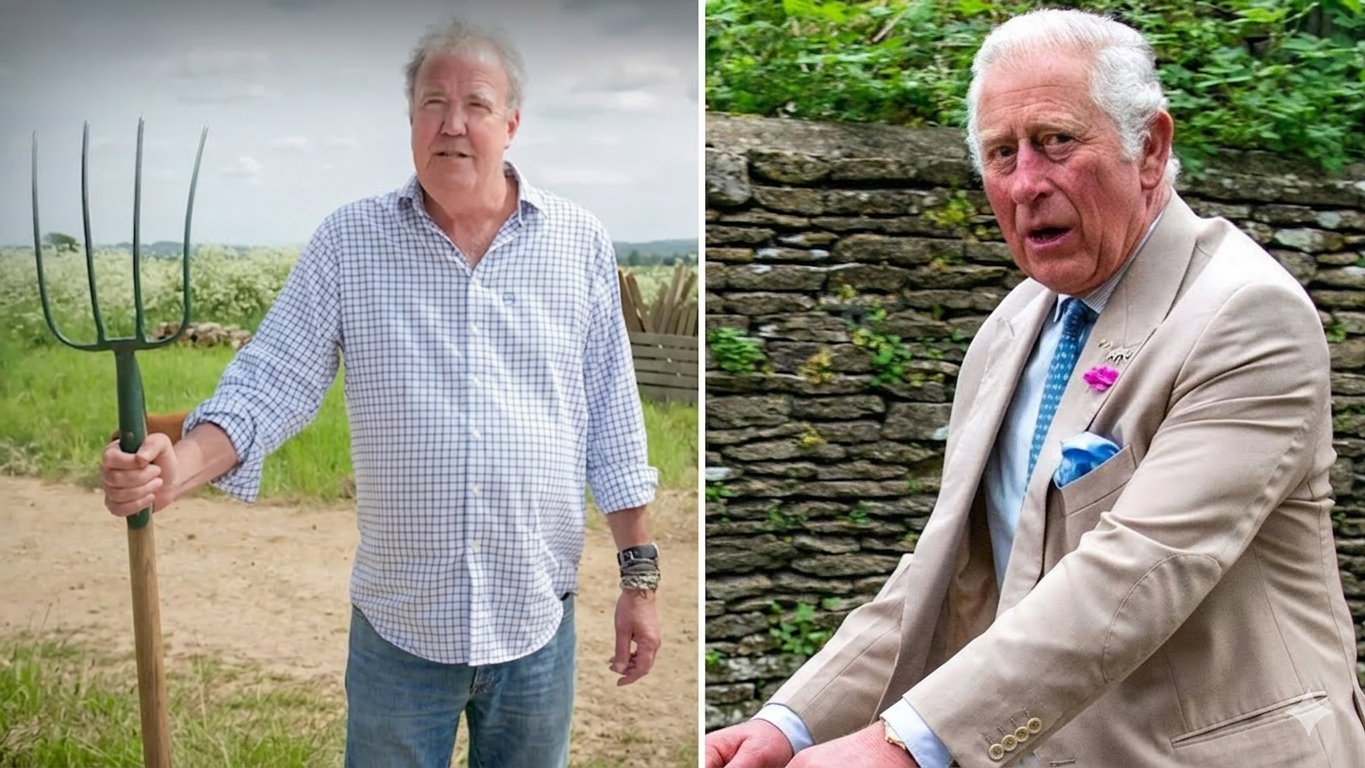
Jeremy Clarkson has launched a fierce attack on what he sees as a growing disconnect between environmental idealism and the economic reality of modern farming, arguing that policies encouraging lower-input agriculture risk pushing working farms towards collapse rather than securing a stable future for the countryside.
Writing in a strongly worded reflection, the Clarkson’s Farm star described hearing King Charles speak on television about the need for British farming to return to nature, reduce chemical use and accept short-term hardship for the sake of long-term environmental health. Clarkson said the message may have sounded gentle and well-intentioned, but insisted it failed to reflect the pressures farmers face every day. In his view, farming is not governed by ideals alone, but by a far less forgiving set of realities: bills, debt, machinery costs, wages and the constant risk of a bad season.
Clarkson’s central argument was simple. Nature, he said, does not send invoices, but banks do. That line captures the wider frustration running through his piece. While many public voices speak of sustainability in terms of biodiversity, soil health and reducing chemical use, he says too little attention is paid to the financial conditions that determine whether a farm survives from one year to the next. For a working farmer, he argues, one poor harvest or one rise in costs is not a philosophical inconvenience but a threat to the entire business.
He backed that argument with his own experience at Diddly Squat, saying he had tried the kind of low-input approach often promoted by advocates of organic or near-organic farming. According to Clarkson, the results were immediate and damaging. Pests increased, weeds spread, crops weakened and yields fell sharply, leaving the farm’s finances under visible strain. He rejected the idea that patience alone can solve such problems, arguing that calls to trust the process are easy to make when one’s own income does not depend on what comes out of the ground in the current season.
The most striking part of Clarkson’s criticism concerns productivity. He argued that organic systems praised in public debate often produce far less wheat per acre than conventional farms using modern fertilisers and pesticides. In his telling, that is not a small efficiency gap but a major structural difference with national consequences. If Britain were to shift too quickly or too widely towards lower-yield models, he warned, domestic food output would fall and the country would become more dependent on imports. That, he suggested, would not amount to environmental leadership but to strategic weakness.
Clarkson also challenged the moral framing often attached to the debate. He made clear that he is not dismissing environmental concerns, saying he lives in and depends on the countryside himself. But he argued that sustainability cannot be defined only in ecological terms. A farm that cannot make money, he wrote, is not sustainable, no matter how attractive its environmental goals may appear. In that sense, he sees the current conversation as dangerously incomplete, because it asks farmers to absorb the cost of change while politicians and campaigners avoid the direct consequences if those policies fail.
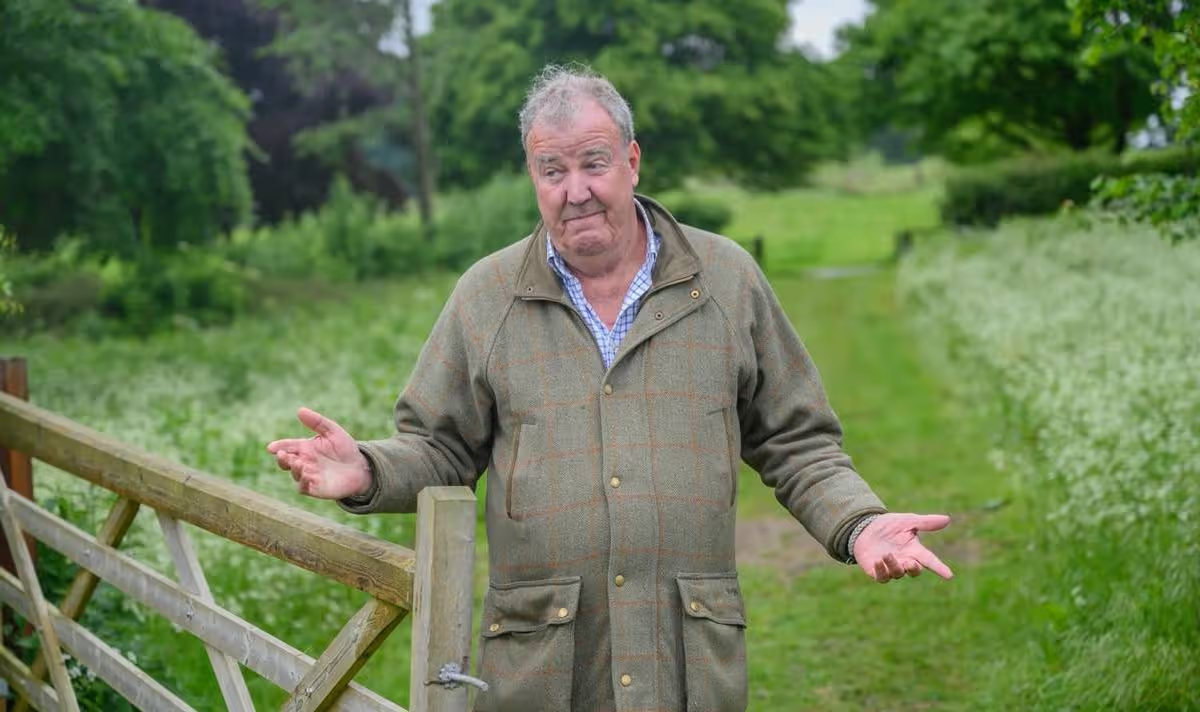
That criticism extended to agricultural policymaking more broadly. Clarkson said the rules shaping the future of farming are too often written in offices by people with little practical exposure to the risks of the job. When policymakers talk about transition, he argued, what they usually mean is that farmers must take on lower yields, higher costs, extra regulation and more uncertainty, often in exchange for support schemes that involve paperwork, delays and payments that do not fully cover the loss. If the policy goes wrong, he wrote, it is the farmer who loses land and livelihood, while the policymaker moves on.
He also warned that reducing domestic production would not remove environmental damage so much as move it elsewhere. Food imports, he argued, may come from countries with lower standards, greater chemical use and long transport chains that create their own emissions burden. In that scenario, Britain could end up congratulating itself for greener policy while simply exporting production and importing risk. Meanwhile, British farmers who intend to pass their land on to the next generation would be forced out, and the countryside would become less a place of work than an asset for investors or developers.
For Clarkson, the deeper issue is not whether farming should change, but who gets to decide what change looks like. He says farmers are not opposed to improving soil health, reducing waste or protecting wildlife. What they oppose, in his view, is being pushed into a model that makes survival harder while being told the hardship is morally necessary. That is why, he argues, rural communities increasingly hear a death sentence where urban audiences hear virtue.
His conclusion was not a call to abandon greener farming altogether, but a warning against what he sees as policy made too quickly and from too far away. Better land management, smarter use of chemicals and genuine environmental gains are all possible, he suggested, but only if they are grounded in working farms and shaped by people who understand the financial limits of the job. Otherwise, he argued, they are not solutions but experiments, and when experiments fail, farms can be lost for good.
