Emma Culligan Discovery Shifts Oak Island Mystery Toward a 19th Century Operation


For years, The Curse of Oak Island has been driven by legends of pirates, secret societies and lost treasure buried deep beneath the island’s ground. But a new line of evidence emerging from the laboratory may be pushing the story in a very different direction.
The latest development centres on archaeologist Emma Culligan and an artifact recovered from Smith’s Cove, one of the most historically significant areas on Oak Island. What first appeared to be an unremarkable lump of corroded iron has now become one of the more intriguing discoveries in the current investigation. Far from confirming old treasure myths, the object may instead point to a coordinated 19th century presence on the island, one that could reshape how the entire mystery is understood.
The discovery began during routine work at Smith’s Cove, where the receding tide exposed muddy and rock-strewn ground long associated with major finds. Metal detection specialist Gary Drayton picked up a strong signal, prompting a difficult excavation through thick mud and stone. The team eventually pulled out a large iron object buried roughly four feet underground.

At first, it seemed to offer little excitement. It was heavily corroded, shapeless and easy to dismiss as scrap left behind by previous searchers. But once the object reached the lab, Culligan’s examination began to change that view. As layers of hardened material were carefully removed, a more recognizable form emerged. The item was identified as a cast iron stove door, likely from the mid-19th century.
On its own, that conclusion might have made the artifact little more than a historical footnote. Oak Island has seen generations of activity, and a stove component from the 1800s would not automatically count as a major breakthrough. What made this item stand out was a decorative symbol etched into its surface: a sharp, symmetrical eight-pointed star.
That detail prompted Culligan to revisit earlier records. In doing so, she reportedly connected the stove door to a much smaller object found years earlier on Lot 5, a button carrying the same unusual symbol. The significance lies not in either object by itself, but in the possibility that both were linked to the same group or phase of activity. Found in different parts of the island, the matching mark suggests a pattern rather than an isolated coincidence.

If that interpretation holds, the implications are considerable. Instead of supporting a story rooted mainly in pirate-era legend, the artifacts may indicate that a more organized and purposeful operation was active on Oak Island during the 19th century. That would shift attention away from romantic theories and toward a period of industrial ambition, mechanical capability and planned excavation.
Culligan’s laboratory analysis added another layer to that argument. According to the transcript, X-ray fluorescence testing found trace amounts of manganese in the stove door. That matters because manganese was increasingly used to strengthen cast iron in the 1860s and 1870s. If accurate, the finding places the artifact far later than the eras often associated with Templar or pirate speculation. In effect, the door becomes not a relic of early legend, but a marker from the age of industry.
That dating opens a more grounded, though no less interesting, set of questions. Who was operating on Oak Island in the late 19th century? Why were marked objects appearing in separate locations? And what sort of work required heavy iron equipment to be brought onto a remote island already tied to underground structures and flood tunnel theories?
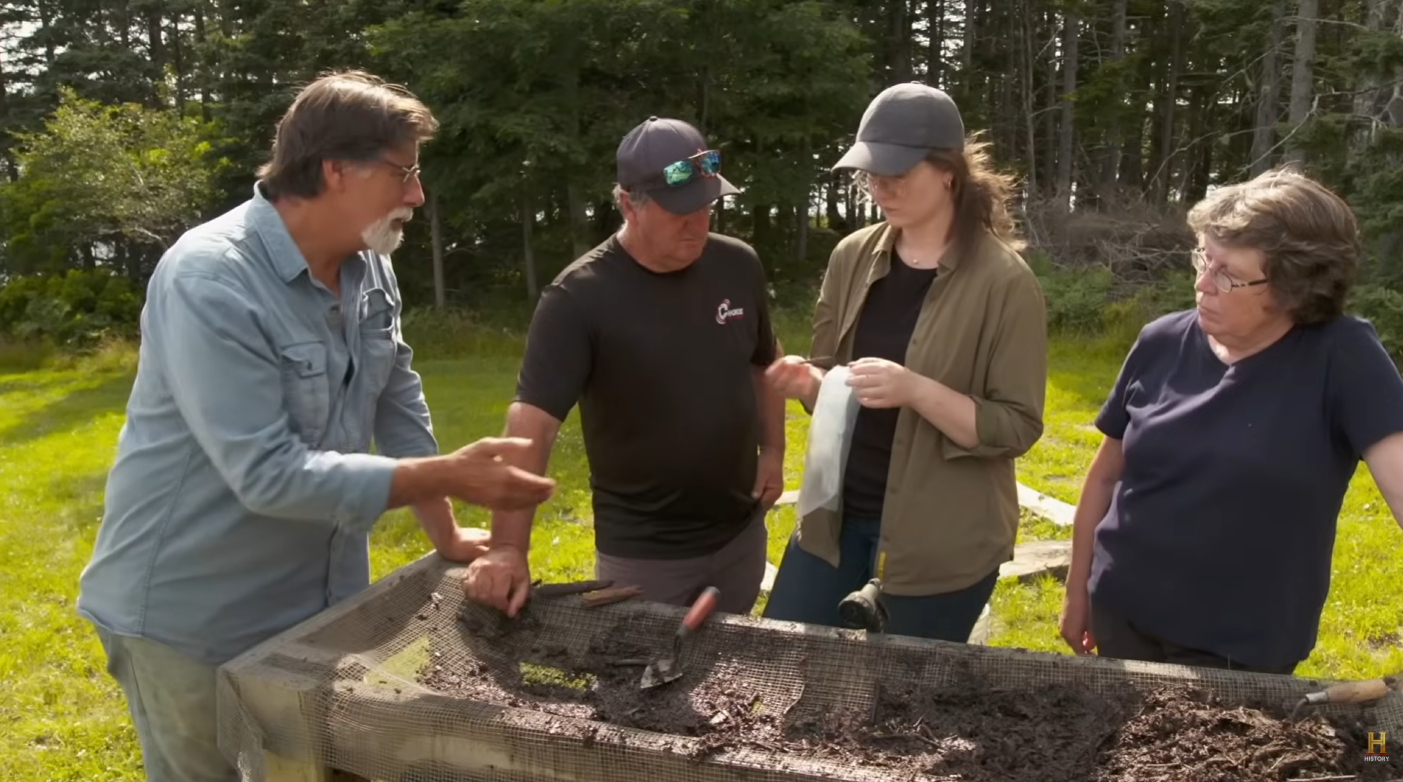
The transcript builds on these questions with broader speculation, suggesting the stove door may have belonged to something more than a domestic heating system. It may have formed part of machinery or site infrastructure connected to excavation, water control or a larger operational base. While those possibilities remain unproven, the core idea is difficult to ignore: the island may contain overlapping layers of history, and not all of them belong to the original treasure legend.
That matters because Oak Island has long been interpreted through a single dominant narrative. Artifacts that seemed too modern were often treated as leftovers from previous searches rather than clues in their own right. But if the stove door and button truly point to the same organized presence, then some of those so-called modern remnants may deserve renewed attention.
In that sense, Culligan’s work may not solve Oak Island, but it could reframe it. The real breakthrough may not be a chest of treasure or a lost manuscript. It may be the realization that the island’s most important story is not simply about what was buried there centuries ago, but about who returned later, worked in secrecy, and left behind a coded trail of their own.
For a mystery built on buried connections, that may be the most important discovery yet.