
A new development in Oak Island season 13 is raising fresh questions about whether the island’s most famous features were ever separate mysteries at all.
According to the latest theory emerging from the ongoing investigation, the long-discussed swamp pathway and the stone formation known as Nolan’s Cross may now be connected by something far more significant than coincidence. If that interpretation holds, it would suggest that Oak Island was not organised around one isolated shaft or one buried cache, but around a carefully planned layout spanning the full length of the island.
For years, the swamp has stood as one of the most puzzling areas of the site. Repeated investigations have pointed to signs of human alteration beneath what appears on the surface to be a natural wetland. Timber, worked material and structured layers below the swamp floor have all contributed to the growing suspicion that this was never simply a marsh left to form on its own. The pathway identified running through the swamp added to that argument, suggesting not only human activity, but intentional design.
The central question, however, was always direction. Why was that pathway built at that precise angle, and where was it meant to lead?
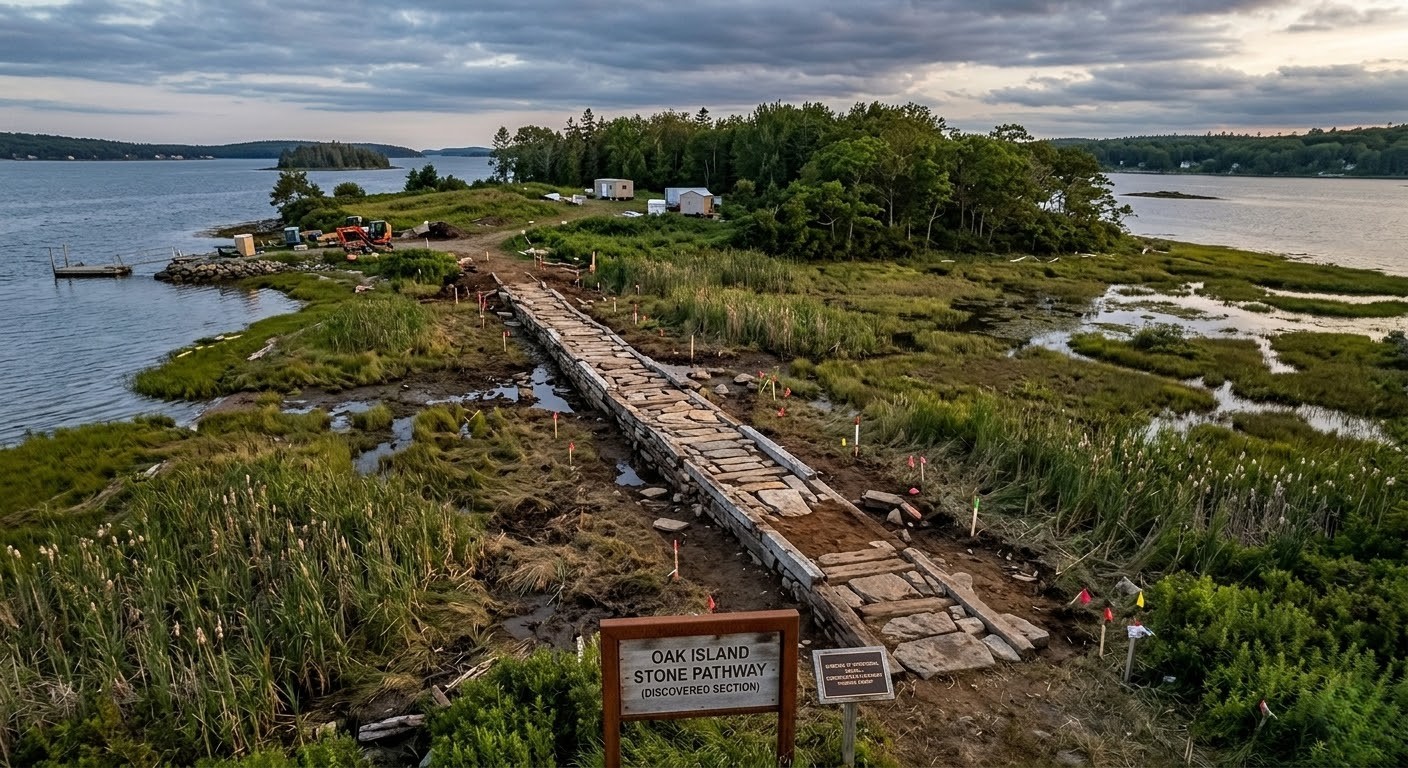
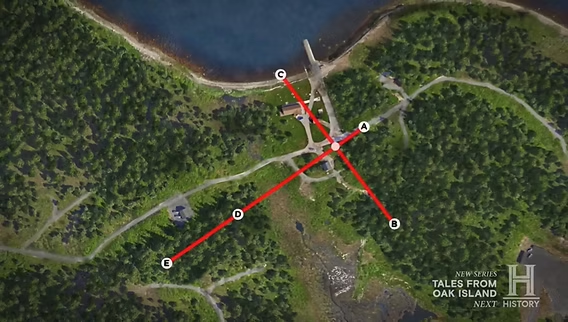
Season 13 appears to offer a possible answer. Survey work described in the latest findings suggests that when the centre line of the swamp pathway was extended northward across the island, it aligned directly with Nolan’s Cross, the massive stone formation first documented by surveyor Fred Nolan in the northern area of Oak Island. The implication is difficult to ignore. If two major features on opposite ends of the island were placed in exact relation to one another, then they may have been part of the same original design.
That would mark a major shift in how the mystery is understood.
Rather than treating the Money Pit, the swamp and Nolan’s Cross as separate clues gathered over two centuries of exploration, the latest interpretation suggests they may all belong to one integrated site plan. In that model, the island itself becomes the real construction, with each major feature positioned deliberately in relation to the others.
Nolan’s Cross has long occupied an unusual place in Oak Island history. To some, it has been a fascinating but unproven anomaly. To others, it has stood as one of the strongest indications that the island contains evidence of deliberate pre-Columbian engineering. Fred Nolan, who spent decades surveying the island, argued that the large granite stones in the north were not random. Their proportions, spacing and geometry, he maintained, pointed to intentional placement. Yet for many years, the cross remained at the edge of the mainstream search narrative, overshadowed by excavation around the Money Pit.
The new alignment theory brings Nolan’s work back into the centre of the story.
If the swamp pathway truly points toward Nolan’s Cross, then the formation is no longer an isolated curiosity. It becomes the northern anchor of a broader axis running across Oak Island. That would mean the original builders, whoever they were, were working at the scale of the whole island rather than focusing on one single burial point.
That idea also raises an obvious next question: where does the Money Pit fit into this geometry?
The latest analysis suggests that the pit may not sit directly on the primary axis formed by the swamp and Nolan’s Cross, but instead at a measured offset from it. That distinction may matter. If deliberate, it could indicate that the pit’s location was chosen according to a wider geometric pattern rather than simple practicality. In other words, its position may have been encoded into the island’s design from the start.
Supporters of this reading argue that such planning would be consistent with medieval European building traditions, particularly those associated with sacred geometry. The theory goes further still, suggesting that the emerging pattern resembles construction principles often linked to the Knights Templar, whose architecture and site layouts have frequently been discussed in connection with Oak Island. While that remains speculative, it adds another layer to an already complex debate over who may have built the island’s underground system and why.
Just as importantly, the alignment theory could affect how the current search proceeds.
For much of Oak Island’s history, exploration has moved from clue to clue, reacting to discoveries as they appear. But if investigators now believe they are dealing with a single planned site, then the search changes from excavation alone to interpretation. Survey points, offsets and geometric relationships could begin to guide where the team looks next, offering a framework rather than a sequence of disconnected leads.
That may prove to be the real significance of this latest development. The swamp pathway’s reported alignment with Nolan’s Cross does not solve the mystery. But it may reveal that Oak Island has been hiding its logic in plain sight all along.
If season 13 continues to build on that idea, then the biggest revelation may not be a treasure chamber or a single artefact. It may be the discovery that the entire island was designed as one coordinated plan — and that, after more than 200 years of searching, the team may finally be starting to read it correctly.
