The Curse of Oak Island Season 13 Episode 19 “Axis of Medieval”: What the Hell Is Going On?


Oak Island may be approaching one of its most consequential episodes in years, with season 13, episode 19 appearing to bring several of the island’s most debated clues into a single, more coherent framework.
For much of the season, the search has moved along multiple tracks at once. The Money Pit has remained the centre of the island’s most aggressive engineering effort. Lot 5 has continued to generate archaeological intrigue through its circular stone feature and surrounding finds. Lot 8, meanwhile, has become increasingly important after the removal of a massive boulder exposed what appeared to be a carefully constructed stone setting beneath it. On their own, each site has raised major questions. What now seems to be changing is the suggestion that they may no longer be separate stories.
The most immediate development appears to be at the Money Pit, where the team’s heavy drilling operation may finally have broken through into the so-called solution channel, a deep subterranean void long seen as one of the most promising targets on the island. That matters because the channel has previously been linked to unusual water chemistry, including traces of silver, and has been viewed by some researchers as the place where collapsed debris from the original Money Pit system may have ended up.

If that breach has indeed occurred, then the excavation has entered a very different phase. Rather than forcing its way through compact layers of earth and rock, the team would now be pulling material from the base of an underground cavity. That opens the possibility of recovering not only geological material, but structural evidence linked to earlier human activity. In the latest preview material, a piece of wood appears to emerge from the spoils, immediately prompting speculation about what it could represent.
That single fragment could carry unusual weight. If analysis were to place it in the era of the first organised searchers, it would support the theory that the team has reached the debris field created by earlier shaft collapses. If, however, the timber proved to be significantly older, it would intensify speculation that the drilling has intersected something closer to the original depositional system itself. At Oak Island, context matters as much as the find, and timber recovered from that depth would demand careful scientific testing before broader conclusions could be drawn.
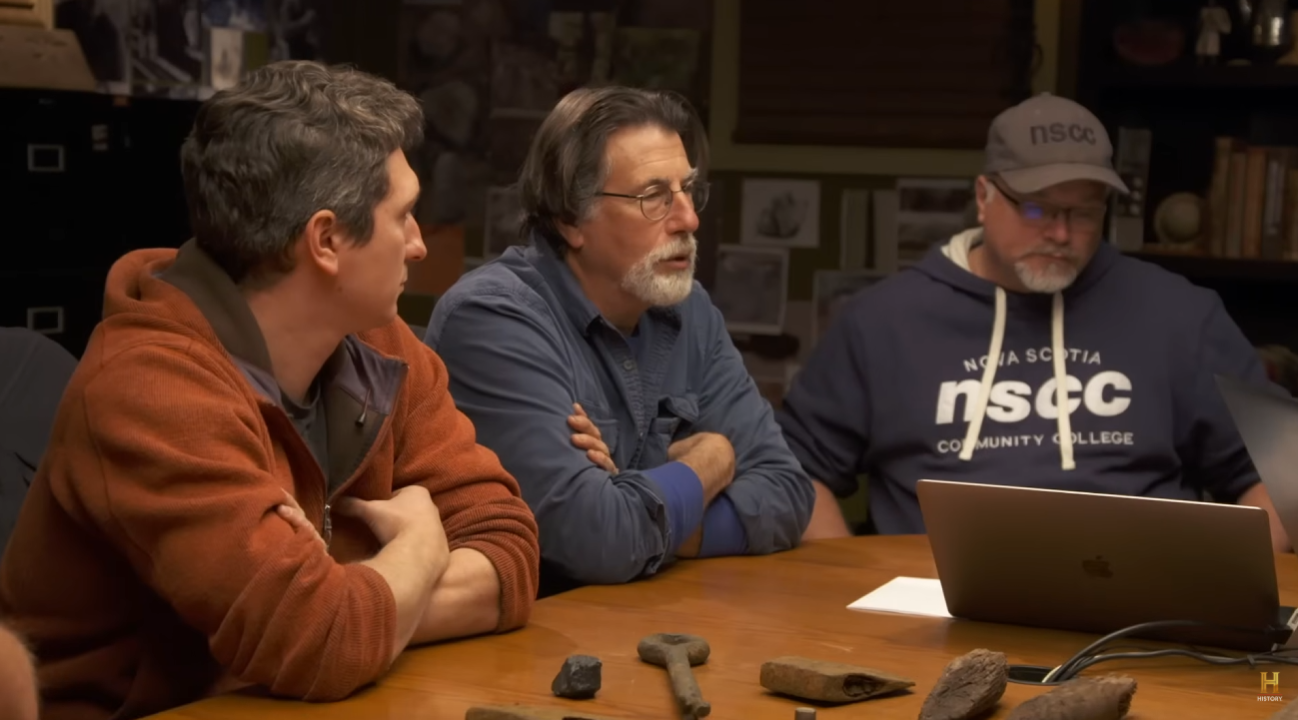
Yet episode 19 is not being framed only around the Money Pit. The title, Axis of Medieval, points strongly toward the war room, where the intellectual side of the search may be catching up with the physical excavation. The latest theory under discussion appears to connect Oak Island to a medieval alignment involving French churches and celestial geometry. At the centre of that argument is Lot 5, where the circular stone formation discovered earlier in the season may now be interpreted as more than a local structure. Instead, it is being presented as a marker within a broader transatlantic design.
That is a striking claim, but it fits a pattern that has gradually gained traction over recent seasons. More of the team’s work has shifted from isolated objects to relationships between places, lines, angles and repeated building methods. If Lot 5 can be credibly linked to a larger geometric system, then Oak Island begins to look less like a cluster of unrelated mysteries and more like a deliberately organised site.
The same logic now seems to be extending to Lot 8.
Earlier this season, the lifting of a 40,000-pound boulder revealed a carefully arranged stone feature packed with blue clay, immediately suggesting deliberate construction rather than natural formation. Now, with excavation continuing beneath that area, the possibility is being raised that the structure may cover the entrance to a shaft or tunnel. If that proves correct, it would have serious implications for how the island is understood.

For generations, the dominant image of Oak Island has been vertical: a shaft, a pit, a flood system and a treasure buried straight down. But a tunnel entrance on Lot 8 would strengthen a different model, one in which the famous Money Pit may have been only one part of a much larger underground design. In that scenario, the island’s builders may have relied on lateral access points, hidden chambers and offset routes rather than a single central vault.
Seen together, the developments at the Money Pit, Lot 5 and Lot 8 begin to suggest something more ambitious than a series of disconnected clues. The Money Pit offers depth and possible material evidence. Lot 5 offers geometry and alignment. Lot 8 offers construction and access. The significance of episode 19 may therefore lie not in one dramatic reveal, but in the possibility that these three sites are beginning to explain one another.
That does not mean the mystery is solved. Oak Island has a long history of promising moments that later required re-evaluation. Wood must be dated. Structures must be interpreted carefully. Alignments must be tested against the risk of overreach. But what makes this stage of the search feel different is that the team appears to be moving beyond isolated hope and toward a working pattern.
If episode 19 delivers what its previews suggest, Oak Island may not yet be giving up its final answer. But it may finally be showing the shape of the system that has hidden that answer for so long.