
Jeremy Clarkson’s instinctive and consistently wrong approach to running his farm is typical of British business leaders. There is a better way, says Rob Anderson
You may think Clarkson’s Farm, the Amazon smash hit following the urbane petrolhead’s frustrated efforts at rural life, is ostensibly a lighthearted reality show. But it’s also the best business programme out there.
Clarkson’s charismatic, instinctive and consistently wrong approach to leadership, moving fast, deciding with confidence and influencing his team, is instantly recognisable to anyone running a British company.
But there is another way. In episode three Jeremy meets Jacob van den Borne, a Dutch potato farmer known by his peers as the Pope of Precision Farming. Since inheriting his farm van den Borne’s yields have improved at roughly one per cent per year, growing from 45-46 tonnes per hectare to 53-54. He has achieved this astonishing level of growth not by working harder, or spending more, but from taking a really good look at his fields before he commits his resources.
Using electromagnetic soil scanning, GPS guidance accurate to the centimetre, moisture sensors at multiple depths, and a yield mapping system he built himself, van den Borne gains an understanding of each field’s productive capacity. He does all this to a level of detail considered madness in traditional farming circles but is driven by his philosophy of “doing the right thing, in the right place, at the right time”.
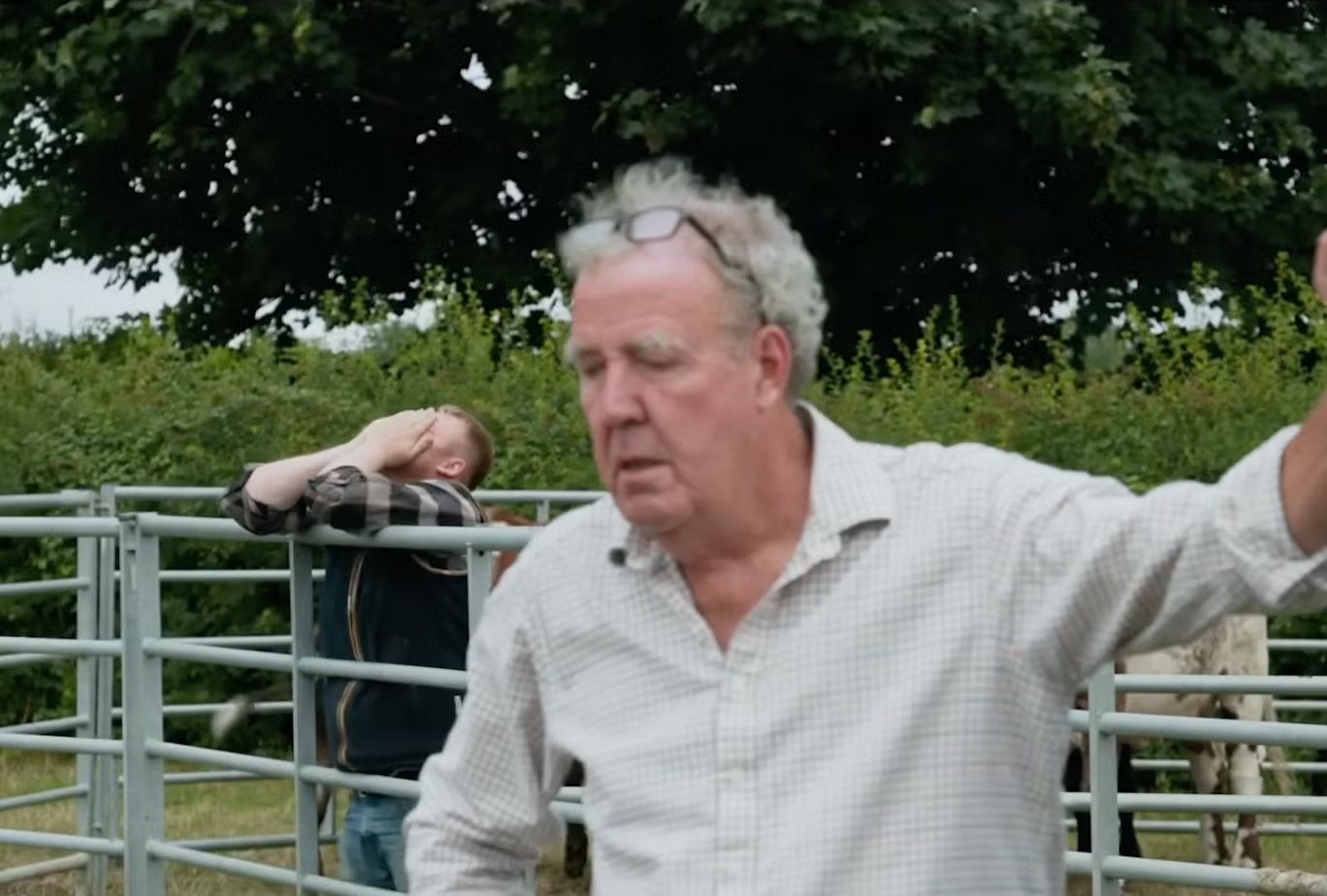
Clarkson looks on dumbfounded, realising he’s been doing everything less efficiently than he could have done.
Clarkson’s realisation maps directly onto one of the most persistent problems in business. Transformation programmes notoriously fail to deliver planned results. Bain & Company research shows that organisations consistently lose between 20 and 25 per cent of their productive capacity to organisational dysfunction. That is, decisions that don’t stick, initiatives that duplicate, change programmes that pile on top of each other until the organisation’s judgement quietly breaks under the weight of bureacracy. None of this appears directly on any financial metric but it is real and we feel it financially further down the line.
Typically I see leaders respond with more, more resource, more reporting, more urgency and more programmes, adding load to a system that was already operating beyond its coherent capacity. This can be summed up brilliantly by a word borrowed from a recent comment on my LinkedIn thread: initiative-itis.
What most businesses do not consider is that this is not a transformation problem, it is a soil problem.
Testing the soil
In an organisation, testing the soil means measuring four things.
How fast do decisions actually move from board to action? Not how fast leadership thinks they move, but how fast they actually move.
Do agreed decisions remain agreed as they travel three layers down? Or are they quietly reinterpreted by the time they reach the people doing the work?
Is working capacity actually deployed against stated priorities? Or is it silently absorbed by legacy commitments nobody has been brave enough to cancel?
And how many concurrent change programmes is the organisation running relative to its actual capacity to absorb them coherently? In my experience, most are running three to five times what the organisation can execute without breaking its own judgement.
Most businesses do not have the data to answer these questions. Execution coherence is assumed because it has been hard to measure. It is not anymore, a structured execution diagnostic, what we call the Execution Coherence Index, maps exactly this terrain. What is missing is the will to run it before the harvest rather than reacting to disappointing results.
This mattered five years ago, it matters more today as AI accelerates our ability to execute. The organisations adding AI capability to an already incoherent execution environment compound errors faster. Those who understand their soil variation are likely to reap the rewards, those who do not must keep reacting with initiatives.
Van den Borne reduced wasted field overlap from 13 per cent to one percent paying back his entire diagnostic investment within three years. The execution equivalent, eliminating the friction, duplication, and initiative overload that most British businesses are carrying, is recoverable at comparable scale.
The difference between Clarkson and van den Borne isn’t intelligence or effort or ambition. It’s the quality of the information they chose to focus on. Van den Borne mapped the soil, Clarkson trusted his gut and blamed the weather.
British business has been blaming the weather for long enough.
